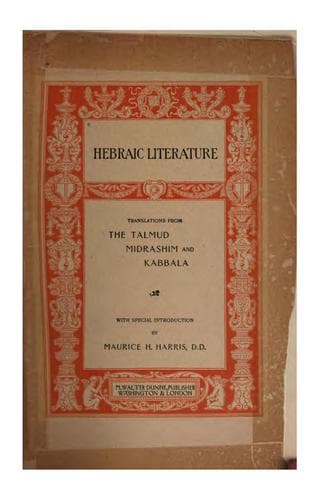
Hebraic Literature; Translations from the Talmud, Midrashim and Kabbala
Religion
Hebraic Literature; Translations from the Talmud, Midrashim and Kabbala
Hebrew literature -- Translations into English
An Arab once said to Rabbah bar Channah, "Come and I will show thee the
place where Korah and his accomplices were swallowed up." "There," says
the Rabbi, "I observed smoke coming out from two cracks in the ground.
Into one of these he inserted some wool tied on to the end of his spear,
and when he drew it out again it was scorched. Then he bade me listen. I
did so, and as I listened heard them groan out, 'Moses and his law are
true, but we are liars.' The Arab then told me that they come round to
this place once in every thirty days, being stirred about in the
hell-surge like meat in the boiling caldron."
_Bava Bathra_, fol. 74, col. 1.
Rabbi Yochanan, in expounding Isa. liv. 12, said, "The Holy One--blessed
be He!--will bring precious stones and pearls, each measuring thirty
cubits by thirty, and polishing them down to twenty cubits by ten, will
place them in the gates of Jerusalem." A certain disciple contemptuously
observed, "No one has ever yet seen a precious stone as large as a small
bird's egg, and is it likely that such immense ones as these have any
existence?" He happened one day after this to go forth on a voyage, and
there in the sea he saw the angels quarrying precious stones and pearls
like those his Rabbi had told him of, and upon inquiry he learned that
they were intended for the gates of Jerusalem. On his return he went
straight to Rabbi Yochanan and told him what he had seen and heard.
"Raca!" said the latter, "hadst thou not seen them thou wouldst have
kept on deriding the words of the wise!" Then fixing his gaze intently
upon him, he with the glance of his eye reduced to a heap of bones the
carcass of his body.
Ibid., fol. 75, col. 1.
He who lends unconditionally a sum of money to his neighbor is not
entitled to demand it back within thirty days thereafter.
_Maccoth_, fol. 3, col. 2.
If a man has lost a relative, he is forbidden to engage in business
until thirty days after the death. In the case of the decease of a
father or a mother, he is not to resume work until his friends rebuke
him and urge him to return.
_Semachoth_, chap. 9.
It is unlawful for one to enter a banqueting-house for thirty days after
the death of a relative; but he must refrain from so doing for twelve
months after the demise of either father or mother, unless on the behest
of some higher requirement of piety.
Ibid.
But I know not whether there are thirty righteous men here and fifteen
in the land of Israel, or _vice versâ_.
_Chullin_, fol. 92, col. 1.
Thirty days in a year are equivalent to a whole year.
_Niddah_, fol. 44, col. 2.
"Moses, thou didst say unto me, 'What is Thy name?' And now thou dost
say, 'Neither hast Thou delivered Thy people at all.' Now shalt thou see
what I will do to Pharaoh (Exod. v. 23, vi. 1), but not what I am about
to do to the thirty-one kings."
_Sanhedrin_, fol. III, col. 1.
Public-domain text, read in full here on John Shaqi.
Reviews
Reviews
No reviews yet
Be the first to share your thoughts on this work.
Elsewhere in the archive
Join the Discussion
Join the discussion
Sign in to leave a comment or review.
Sign InorCreate an account