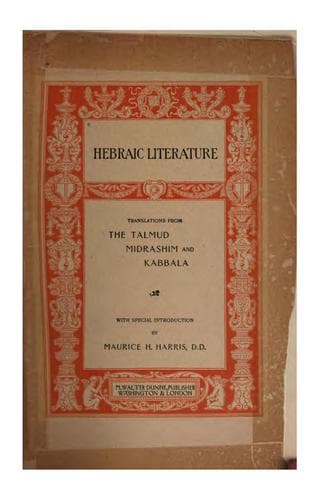
Hebraic Literature; Translations from the Talmud, Midrashim and Kabbala
Religion
Hebraic Literature; Translations from the Talmud, Midrashim and Kabbala
Hebrew literature -- Translations into English
Rabbi Eliezer asked, "For whose benefit were those seventy bullocks
intended?" See Num. xxix. 12-36. For the seventy nations into which the
Gentile world is divided; and Rashi plainly asserts that the seventy
bullocks were intended to atone for them, that rain might descend all
over the world, for on the Feast of Tabernacles judgment is given
respecting rain, etc. Woe to the Gentile nations for their loss, and
they know not what they have lost! for as long as the Temple existed,
the altar made atonement for them; but now, who is to atone for them?
_Succah_, fol. 55, col. 2.
Choni, the Maagol, once saw in his travels an old man planting a
carob-tree, and he asked him when he thought the tree would bear fruit.
"After seventy years," was the reply. "What!" said Choni, "dost thou
expect to live seventy years and eat the fruit of thy labor?" "I did not
find the world desolate when I entered it," said the old man; "and as my
fathers planted for me before I was born, so I plant for those that will
come after me."
_Taanith_, fol. 23, col. 1.
Mordecai was one of those who sat in the hall of the Temple, and he knew
seventy languages.
_Megillah_, fol. 13, col. 2.
The Rabbis have taught:--During a prosperous year in Israel, a place
that is sown with a single measure of seed produces five myriad cors of
grain. In the tilled districts of Zoan, one measure of seed produces
seventy cors; for we are told that Rabbi Meir said he himself had
witnessed in the vale of Bethshean an instance of one measure of seed
producing seventy cors. And there is no better land anywhere than the
land of Egypt; for it is said, "As the garden of the Lord, like the land
of Egypt." And there is no better land in ail Egypt than Zoan, where
several kings have resided; for it is written (Isa. xxx. 4), "His
princes were in Zoan." In all Israel there was no more unsuitable soil
than Hebron, for it was a burying-place, and yet Hebron was seven times
more prolific than Zoan; for it is written (Num. xiii. 22), "Now Hebron
was built seven years before Zoan in Egypt." For it is said (Gen. x. 6),
"And the sons of Ham, Cush, Mizraim (that is, Egypt), Phut, and Canaan"
(that is, Israel). It must, therefore, mean that it was seven times more
prolific (the verb meaning both to build and to produce) than Zoan. This
is only in the unsuitable soil of the land of Israel, Hebron, but in the
suitable soil (the increase) is five hundred times. All this applies to
a year of average return, but in one of special prosperity, it is
written (Gen. xxvi. 12), "Then Isaac sowed in that land, and received in
the same year an hundredfold, and the Lord blessed him." (The word
years, is conveniently overlooked in working out the argument.)
_Kethuboth_, fol. 112, col. 1.
Public-domain text, read in full here on John Shaqi.
Reviews
Reviews
No reviews yet
Be the first to share your thoughts on this work.
Elsewhere in the archive
Join the Discussion
Join the discussion
Sign in to leave a comment or review.
Sign InorCreate an account