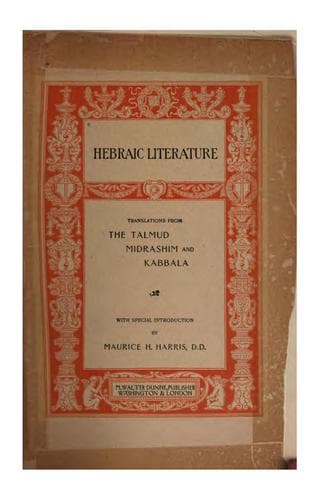
Hebraic Literature; Translations from the Talmud, Midrashim and Kabbala
Religion
Hebraic Literature; Translations from the Talmud, Midrashim and Kabbala
Hebrew literature -- Translations into English
The astrologers in Egypt said to Pharaoh, "What! shall a slave whose
master bought him for twenty pieces of silver rule over us?" Pharaoh
replied, "But I find him endowed with kingly qualities." "If that is the
case," they answered, "he must know seventy languages." Then came the
angel Gabriel, and taught him seventy languages.
_Soteh_, fol. 36, col. 2.
When the leviathan makes the deep boil, the sea does not recover its
calm for seventy years; for it is said (Job xli. 32), "One would think
the deep is to be hoary," and we cannot take the word "hoary" to imply a
term of less than seventy years.
_Bava Bathra_, fol. 75, col. 1.
Abba Chalepha Keruya once remarked to Rav Cheyah bar Abba, "The sum
total of Jacob's family thou findest reckoned at seventy, whereas the
numbers added up make only sixty-nine. How is that?" Rav Cheyah made
answer that the particle in verse 15, implies that Dinah must have been
one of twin-sisters. "But," objected the other, "the same particle
occurs also in connection with Benjamin, to say nothing of other
instances." "Alas!" said Rav Cheyah, "I am possessed of a secret worth
knowing, and thou art trying to worm it out of me." Then interposed Rav
Chama bar Chanena, "The number may be made up by reckoning Jochebed in,
for of her it is said (Num. xxvi. 59) 'that her mother bare her to Levi
in Egypt;' her birth took place in Egypt, though she was conceived on
the journey."
_Bava Bathra_, fol. 123, cols, 1, 2.
Rav Yehudah says in the name of Shemuel:--There is yet another festival
in Rome, which is observed only once in seventy years, and this is the
manner of its celebration. They take an able-bodied man, without
physical defect, and cause him to ride upon the back of a lame one. They
dress up the former in the garments of Adam (such as God made for him in
Paradise), and cover his face with the skin of the face of Rabbi
Ishmael, the high priest, and adorn his neck with a precious stone. They
illuminate the streets, and then lead the two men through the city, a
herald proclaiming before them, "The account of our Lord was false; it
is the brother of our Lord that is the deceiver! He that sees this
festival sees it, and he that does not see it now will never see it.
What advantage to the deceiver is his deception, and to the crafty his
craftiness?" The proclamation finishes up thus--"Woe to this one when
the other shall rise again!"
_Avodah Zarah_, fol. 11, col. 2.
Public-domain text, read in full here on John Shaqi.
Reviews
Reviews
No reviews yet
Be the first to share your thoughts on this work.
Elsewhere in the archive
Join the Discussion
Join the discussion
Sign in to leave a comment or review.
Sign InorCreate an account