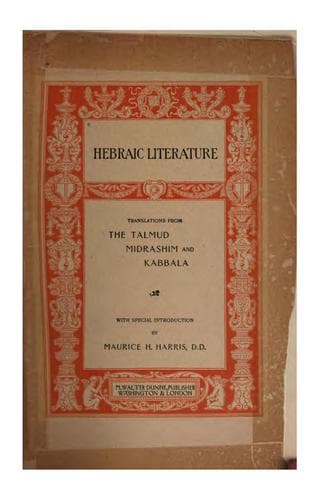
Hebraic Literature; Translations from the Talmud, Midrashim and Kabbala
Religion
Hebraic Literature; Translations from the Talmud, Midrashim and Kabbala
Hebrew literature -- Translations into English
gratuitously among the poor of the city a banquet he had
prepared for the governor, but of which the governor did not
come to partake." The disciple having asked the Rabbi how long
this publican was to be thus severely treated, he replied,
"Until the death of Simeon the son of Shetach, who is to take
the publican's place in Gehenna." "Why so?" "Because, though he
knows there are several Jewish witches in Askelon, he idly
suffers them to ply their infernal trade and does not take any
steps to extirpate them." On the morrow the disciple reported
this speech to Simeon the son of Shetach, who at once proceeded
to take action against the obnoxious witches. He engaged eighty
stalwart young men, and choosing a rainy day, supplied each with
an extra garment folded up and stowed away in an earthern
vessel. Thus provided, they were each at a given signal to
snatch up one of the eighty witches and carry her away, a task
they would find of easy execution, as, except in contact with
the earth, these creatures were powerless. Then Simeon the son
of Shetach, leaving his men in ambush, entered the rendezvous of
the witches, who, accosting him, asked, "Who art thou?" He
replied, "I am a wizard, and am come to experiment in magic."
"What trick have you to show?" they said. He answered, "Even
though the day is wet, I can produce eighty young men all in dry
clothes." They smiled incredulously and said, "Let us see!" He
went to the door, and at the signal the young men took the dry
clothes out of the jars and put them on, then starting from
their ambush, they rushed into the witches' den, and each
seizing one, lifted her up and carried her off as directed. Thus
overpowered, they were brought before the court, convicted of
malpractices and led forth to execution.
_Sanhedrin_, fol. 44, col. 2.
(Exod. xxiii. 35), "And I will take away sickness from the midst of
thee." It is taught that sickness (Machlah) means the bile. But why is
it termed Machlah? Because eighty-three diseases are in it. Machlah by
Gematria equals eighty-three; and all may be avoided by an early
breakfast of bread and salt and a bottle of water.
_Bava Kama_, fol. 92, col. 2.
If in a book of the law the writing is obliterated all but eighty-five
letters--as, for instance, in Num. x. 35, 36, "And it came to pass when
the ark set forward," etc.,--it may be rescued on the Sabbath from a
fire, but not otherwise.
_Shabbath_, fol. 116, col. 1.
Elijah said to Rabbi Judah the brother of Rav Salla the Pious, "The
world will not last less than eighty-five jubilees, and in the last
jubilee the son of David will come."
_Sanhedrin_, fol. 97, col 2.
There was not a single individual in Israel who had not ninety Lybian
donkeys laden with the gold and silver of Egypt.
_Bechoroth_, fol. 5, col. 2.
Public-domain text, read in full here on John Shaqi.
Reviews
Reviews
No reviews yet
Be the first to share your thoughts on this work.
Elsewhere in the archive
Join the Discussion
Join the discussion
Sign in to leave a comment or review.
Sign InorCreate an account