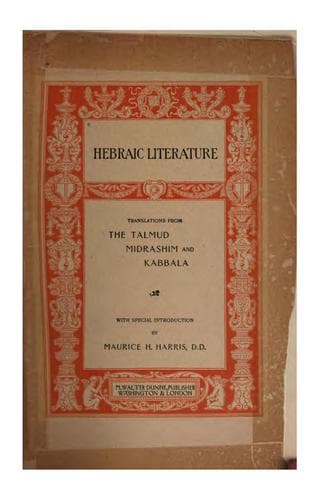
Hebraic Literature; Translations from the Talmud, Midrashim and Kabbala
Religion
Hebraic Literature; Translations from the Talmud, Midrashim and Kabbala
Hebrew literature -- Translations into English
(2 Sam. xix. 35), "Can thy servant taste what I eat or what I drink?"
From this we learn that in the aged the sense of taste is destroyed....
Rav says, "Barzillai the Gileadite reports falsely, for the cook at the
house of Rabbi (the Holy) was ninety-two years old, and yet could judge
by taste of what was cooking in the pot."
_Shabbath_, fol. 152, col. 1.
Rava said, "Life, children, and competency do not depend on one's merit,
but on luck; for instance, Rabbah and Rav Chasda were both righteous
Rabbis; the one prayed for rain and it came, and the other did so
likewise with the like result; yet Rav Chasda lived ninety-two years and
Rabbah only forty. Rav Chasda, moreover, had sixty weddings in his
family during his lifetime, whereas Rabbah had sixty serious illnesses
in his during the short period of his life. At the house of the former
even the dogs refused to eat bread made of the finest wheat flour,
whereas the family of the latter were content to eat rough bread of
barley and could not always obtain it." Rava also added, "For these
three things I prayed to Heaven, two of which were and one was not
granted unto me. I prayed for the wisdom of Rav Hunna and for the riches
of Rav Chasda, and both these were granted unto me; but the humility and
meekness of Rabbah, the son of Rav Hunna, for which I also prayed, was
not granted."
_Moed Katon_, fol. 28, col. 1.
The judges who issued decrees at Jerusalem received for salary
ninety-nine manahs from the contributions of the chamber.
_Kethuboth_, fol. 105, col. 1.
Ninety-nine die from an evil eye for one who dies in the usual manner.
_Bava Metzia_, fol. 107, col. 2.
The Rabbis have taught us who they are that are to be accounted rich.
"Every one," says Rabbi Meir, "who enjoys his riches." But Rabbi Tarphon
says, "Every one who has a hundred vineyards and a hundred fields, with
a hundred slaves to labor in them." Rabbi Akiva pronounces him well off
who has a wife that is becoming in all her ways.
_Shabbath_, fol. 25, col. 2.
A light for one is a light for a hundred.
Ibid., fol. 122, col. 1.
When a Gentile lights a candle or a lamp on the Sabbath-eve for his own
use, an Israelite is permitted to avail himself of its light, as a light
for one is a light for a hundred; but it is unlawful for an Israelite to
order a Gentile to kindle a light for his use.
A hundred Rav Papas and not one (like) Ravina!
A hundred zouzim employed in commerce will allow the merchant meat and
wine at his table daily, but a hundred zouzim employed in farming will
allow their owner only salt and vegetables.
_Yevamoth_, fol. 63, col. 1.
A hundred women are equal to only one witness (compare Deut. xvii. 6 and
xix. 15).
Ibid., fol. 88, col. 2.
If song should cease, a hundred geese or a hundred measures of wheat
might be offered for one zouz, and even then the buyer would refuse
paying such a sum for them.
_Soteh_, fol. 48, col. 1.
Public-domain text, read in full here on John Shaqi.
Reviews
Reviews
No reviews yet
Be the first to share your thoughts on this work.
Elsewhere in the archive
Join the Discussion
Join the discussion
Sign in to leave a comment or review.
Sign InorCreate an account