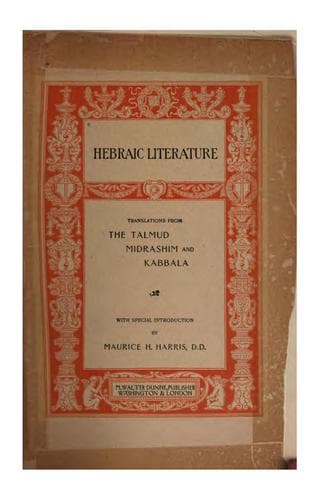
Hebraic Literature; Translations from the Talmud, Midrashim and Kabbala
Religion
Hebraic Literature; Translations from the Talmud, Midrashim and Kabbala
Hebrew literature -- Translations into English
This duty, as Rashi tells us, is based upon Deut. x. 12,
altering the word what into a hundred, by the addition of a
letter.
This is what the so-called Pagan Goethe, intent on self-culture
as the first if not the final duty of man, makes Serlo in his
"Meister" lay down as a rule which one should observe daily.
"One," he says, "ought every day to hear a little song, read a
good poem, see a fine picture, and, if possible, speak a few
reasonable words." The contrast between this advice and that of
the Talmud here and elsewhere is suggestive of reflections.
He who possesses one manah may buy, in addition to his bread, a litra of
vegetables; the owner of ten manahs may add to his bread a litra of
fish; he that has fifty manahs may add a litra of meat; while the
possessor of a hundred may have pottage every day.
_Chullin_, fol. 84, col. 1.
Ben Hey-Hey said to Hillel, "What does this mean that is written in Mal.
iii. 18, 'Then shall ye return, and discern between the righteous and
the wicked, between him that serveth God and him that serveth Him not'?
Does the righteous here mean him that serveth God, and the wicked him
that serveth Him not? Why this repetition?" To this Hillel replied, "The
expressions, 'he that serveth God, and he that serveth Him not,' are
both to be understood as denoting 'perfectly righteous,' but he who
repeats his lesson a hundred times is not to be compared with one who
repeats it a hundred and one times." Then said Ben Hey-Hey, "What!
because he has repeated what he has learned only one time less than the
other, is he to be considered as 'one who serveth Him not'?" "Yes!" was
the reply; "go and learn a lesson from the published tariff of the
donkey-drivers--ten miles for one zouz, eleven for two."
_Chaggigah_, fol. 9, col. 2.
Hillel was great and good and clever, but his exposition of
Scripture, as we see from the above, is not always to be
depended upon. If, indeed, he was the teacher of Jesus, as some
suppose him to have been, then Jesus must, even from a
Rabbinical stand-point, be regarded as greater than Hillel the
Great, for He never handled the Scriptures with such
irreverence.
One hundred and three chapters (or psalms) were uttered by David, and he
did not pronounce the word Hallelujah until he came to contemplate the
downfall of the wicked; as it is written (Ps. civ. 35), "Let the sinners
be consumed out of the earth, and let the wicked be no more. Bless the
Lord, O my soul, Hallelujah!" Instead of one hundred and three we ought
to say a hundred and four, but we infer from this that "Blessed is the
man," etc., and "Why do the heathen rage?" etc., are but one psalm.
_Berachoth_, fol. 9, col. 2.
Public-domain text, read in full here on John Shaqi.
Reviews
Reviews
No reviews yet
Be the first to share your thoughts on this work.
Elsewhere in the archive
Join the Discussion
Join the discussion
Sign in to leave a comment or review.
Sign InorCreate an account