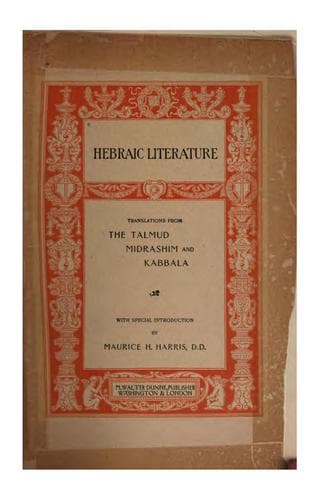
Hebraic Literature; Translations from the Talmud, Midrashim and Kabbala
Religion
Hebraic Literature; Translations from the Talmud, Midrashim and Kabbala
Hebrew literature -- Translations into English
One of the most charming women that we find figuring in the
Talmud was the wife of Rabbi Meir, Beruriah by name; and as we
meet with her in the immediate context of the above quotation,
it may be well to introduce her here to the attention of the
reader. The context speaks of a set of ignorant fellows
(probably Greeks) who sorely vexed the soul of Rabbi Meir, her
husband, and he ardently prayed God to take them away. Then
Beruriah reasoned with her husband thus:--"Is it, pray, because
it is written (Ps. civ. 35), 'Let the sinners be consumed'? It
is not written 'sinners,' but 'sins.' Besides, a little farther
on in the text it is said, 'And the wicked will be no more;'
that is to say, 'Let sins cease, and the wicked will cease too.'
Pray, therefore, on their behalf that they may be led to
repentance, and these wicked will be no more." This he therefore
did, and they repented and ceased to vex him. Of this excellent
and humane woman it may well be said, "She openeth her mouth
with wisdom, and in her tongue is the law of kindness" (Prov.
xxxi. 26). Her end was tragic. She was entrapped by a disciple
of her husband, and out of shame she committed suicide. See
particulars by Rashi in Avodah Zarah, fol. 18, col. 2.
The Hasmoneans ruled over Israel during the time of the second Temple a
hundred and three years; and for a hundred and three the government was
in the hands of the family of Herod.
_Avodah Zarah_, fol. 9, col. 1.
Rabbi Yochanan the son of Zacchai lived a hundred and twenty years;
forty he devoted to commerce, forty to study, and forty to teaching.
_Rosh Hashanah_, fol. 30, col. 2.
One hundred and twenty elders, and among them several prophets, bore a
part in composing the Eighteen Blessings (the Shemonah Esreh).
_Meggillah_, fol. 17, col. 2.
A similar tradition was current among the early Christians, with
reference to the composition of the Creed. Its different
sentences were ascribed to different apostles. However fitly
this tradition may represent the community of faith with which
the prophets on the one hand and the apostles on the other were
inspired, it is not recommended by the critic as a proceeding
calculated to ensure unity in a work of art.
Public-domain text, read in full here on John Shaqi.
Reviews
Reviews
No reviews yet
Be the first to share your thoughts on this work.
Elsewhere in the archive
Join the Discussion
Join the discussion
Sign in to leave a comment or review.
Sign InorCreate an account