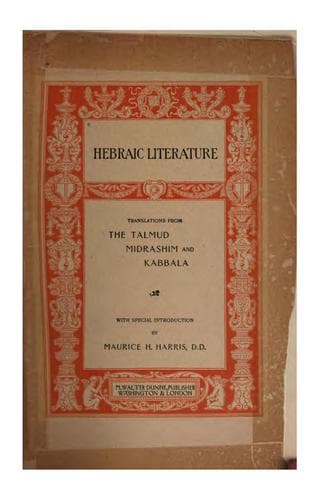
Hebraic Literature; Translations from the Talmud, Midrashim and Kabbala
Religion
Hebraic Literature; Translations from the Talmud, Midrashim and Kabbala
Hebrew literature -- Translations into English
Rabbi Shemuel says advantage may be taken of the mistakes of a Gentile.
He once bought a gold plate as a copper one of a Gentile for four
zouzim, and then cheated him out of one zouz into the bargain. Rav
Cahana purchased a hundred and twenty vessels of wine from a Gentile for
a hundred zouzim, and swindled him in the payment out of one of the
hundred, and that while the Gentile assured him that he confidently
trusted to his honesty. Rava once went shares with a Gentile and bought
a tree, which was cut up into logs. This done, he bade his servant go to
pick him out the largest logs, but to be sure to take no more than the
proper number, because the Gentile knew how many there were. As Rav Ashi
was walking abroad one day he saw some grapes growing in a roadside
vineyard, and sent his servant to see whom they belonged to. "If they
belong to a Gentile," he said, "bring some here to me; but if they
belong to an Israelite, do not meddle with them." The owner, who
happened to be in the vineyard, overheard the Rabbi's order and called
out, "What! is it lawful to rob a Gentile?" "Oh, no," said the Rabbi
evasively; "a Gentile might sell, but an Israelite would not."
_Bava Kama_, fol. 113, col. 2.
This is given simply as a sample of the teaching of the Talmud
on the subject both by precept and example. There is no
intention to cast a slight on general Jewish integrity, or
suggest distrust in regard to their ethical creed.
Rabbon Gamliel, Rabbi Eliezer ben Azaryah, Rabbi Yehoshua, and Rabbi
Akiva once went on a journey to Rome, and at Puteoli they already heard
the noisy din of the city, though at a distance of a hundred and twenty
miles. At the sound all shed tears except Akiva, who began to laugh.
"Why laughest thou?" they asked. "Why do you cry?" he retorted. They
answered, "These Romans, who worship idols of wood and stone and offer
incense to stars and planets, abide in peace and quietness, while our
Temple, which was the footstool of our God, is consumed by fire; how can
we help weeping?" "That is just the very reason," said he, "why I
rejoice; for if such be the lot of those who transgress His laws, what
shall the lot of those be who observe and do them?"
_Maccoth_, fol. 24, col. 2.
When Adam observed that his sin was the cause of the decree which made
death universal he fasted one hundred and thirty years, abstained all
that space from intercourse with his wife, and wore girdles of
fig-leaves round his loins. All these years he lived under divine
displeasure, and begat devils, demons, and spectres; as it is said (Gen.
v. 3), "And Adam lived a hundred and thirty years, and begat in his own
likeness, after his image," which implies that, until the close of those
years, his offspring were not after his own image.
_Eiruvin_, fol. 18, col. 2.
Public-domain text, read in full here on John Shaqi.
Reviews
Reviews
No reviews yet
Be the first to share your thoughts on this work.
Elsewhere in the archive
Join the Discussion
Join the discussion
Sign in to leave a comment or review.
Sign InorCreate an account