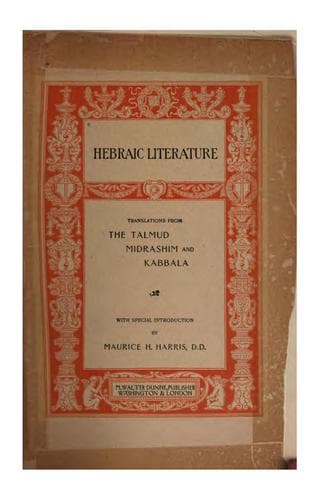
Hebraic Literature; Translations from the Talmud, Midrashim and Kabbala
Religion
Hebraic Literature; Translations from the Talmud, Midrashim and Kabbala
Hebrew literature -- Translations into English
When Rabbi Eliezer, on his deathbed, taught Rabbi Akiva three hundred
particulars to be observed in regard to the white spot covered with hair
which was the sign of leprosy, the former lifted up his arms and placed
them on his chest and exclaimed, "Woe is me, because of these my two
arms, these two scrolls of the law, that are about to depart from this
world; for if all the seas were ink, and all the reeds were quills, and
all the men were scribes, they could not record all I have learned and
all I have taught, and how much I have heard at the lips of sages in the
schools. And what is more, I also taught three hundred laws based on the
text, 'A witch shall not live.'"
_Avoth d'Rab. Nathan_, chap. 25.
This truly Oriental exaggeration, which Rabbi Eliezer ben
Azariah so complacently applies to himself, was spoken also of
Rabbi Yochanan before him (Bereshith Rabba); an acrostic poem in
the Morning Service for Pentecost adopts the same hyperbole
almost word for word, and turns it to very pious account. It is
interesting to note how contemporary sacred literature abounds
in similar hyperbolic expressions. In John xxi 25 it is said,
"There are also many other things which Jesus did, the which, if
they should be written every one, I suppose that even the world
itself could not contain the books that should be written."
Cicero, too, speaks of a glory of such a weight that even heaven
itself is scarcely able to contain it; and Livy, on one
occasion, describes the power of Rome as with difficulty
restrained within the limits of the world.
Here it may not be out of place if we introduce a few of the
many passages in the Talmud that treat of enchantment and
witchcraft, as well as magic, charms, and omens. The list of
quotations might be extended to a hundred, but we must confine
ourselves to a score or so.
The daughters of Israel burn incense for (purposes of) sorcery.
_Berachoth_, fol. 53, col. 1.
Ben Azai (son of impudence), says, "... he who seats himself and then
feels ... (which must not be explained), the effects of witchcraft, even
when practiced in Spain, will come upon him. What is the remedy when one
forgets and first sits down and then feels?.... When he rises let him
say, 'Not these and not of these; not the witchcraft of sorcerers and
not the sorcery of witches.'"
_Berachoth_, fol. 62, col. 1.
The daughters of Israel in later generations lapsed into the practice of
witchcraft.
_Eiruvin_ fol. 64, col. 2.
Public-domain text, read in full here on John Shaqi.
Reviews
Reviews
No reviews yet
Be the first to share your thoughts on this work.
Elsewhere in the archive
Join the Discussion
Join the discussion
Sign in to leave a comment or review.
Sign InorCreate an account