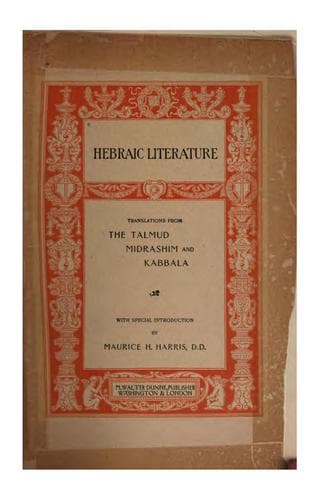
Hebraic Literature; Translations from the Talmud, Midrashim and Kabbala
Religion
Hebraic Literature; Translations from the Talmud, Midrashim and Kabbala
Hebrew literature -- Translations into English
"By the term witch," the Rabbis say, "we are to understand either male
or female." "If so," it is asked, "why the term 'witch,' in Exod. xxii.
18, in the Hebrew verse 17, is in the feminine gender?" "Because," it is
answered, "most women are witches."
Ibid., fol. 67, col. 1.
If the proud (in Israel) were to cease, the magicians would also cease;
as it is written (Isa. i. 25), "I will purge away thy dross and take
away all thy tin."
Ibid., fol. 98, col. 1.
Among those who have no portion in the world to come is he who reads the
books of the strangers, foreign books, books of outsiders. See also
Sanhedrin, fol. 90, col. 1. Now Rav Yoseph says, "It is unlawful to read
the Book of the Son of Sirach, ... because it is written therein
(Ecclesiasticus xlii. 9, etc., as quoted, or rather misquoted, in the
Talmud), 'A daughter is a false treasure to her father: because of
anxiety for her he cannot sleep at night; when she is young, for fear
she should be seduced; in her virginity lest she play the harlot; in her
marriageable age, lest she should not get married; and when married,
lest she should be childless; and when grown old, lest she practice
witchcraft.'"
_Sanhedrin_, fol. 100, col. 2.
He who multiplieth wives multiplieth witchcraft.
_Avoth_, chap. 2.
Most donkey-drivers are wicked, but most sailors are pious. The best
physicians are destined for hell, the most upright butcher is a partner
of Amalek. Bastards are mostly cunning, and servants mostly handsome.
Those who are well-descended are bashful, and children mostly resemble
their mother's brother. Rabbi Shimon ben Yochai bids us "kill the best
of Gentiles" (modern editions qualify this by adding, in time of war),
"and smash the head of the best of serpents." "The best among women," he
says, "is a witch." Blessed is he who does the will of God!
_Sophrim_, chap. 15, hal. 10.
On the Sabbath one may carry a grasshopper's egg as a charm against
earache, the tooth of a living fox to promote sleep, the tooth of a dead
fox to prevent sleep, and the nail of one crucified (as a remedy) for
inflammation or swelling. For cutaneous disorders he is to repeat Baz
Baziah, Mass Massiah, Cass Cassiah, Sharlaii, and Amarlaii (names of
angels), etc.... As the mules do not increase and multiply, so may the
skin disease not increase and spread upon the body of N., the son of the
woman N., etc.
_Shabbath_, fol. 67, col. 1.
Public-domain text, read in full here on John Shaqi.
Reviews
Reviews
No reviews yet
Be the first to share your thoughts on this work.
Elsewhere in the archive
Join the Discussion
Join the discussion
Sign in to leave a comment or review.
Sign InorCreate an account