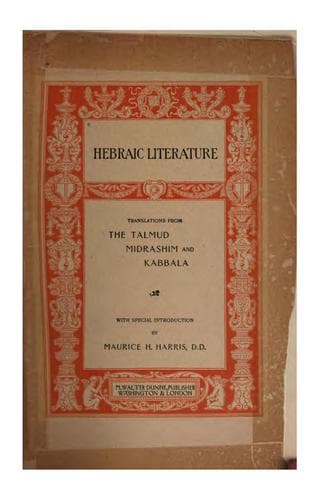
Hebraic Literature; Translations from the Talmud, Midrashim and Kabbala
Religion
Hebraic Literature; Translations from the Talmud, Midrashim and Kabbala
Hebrew literature -- Translations into English
Rav Yitzchak said, "What is the meaning of that which is written (Ps.
cxl. 8), 'Grant not, O Lord, the desires of the wicked; further not his
wicked device, lest they exalt themselves. Selah?'" It is the prayer of
Jacob to the Lord of the universe that He would not grant to Esau, "the
wicked, the desires of his heart." "Further not his wicked device," this
refers to Germamia of Edom (i.e., Rome), for if they (the Romans) were
suffered to go forward they would destroy the whole world! Rav Chama bar
Chanena said, "There are three hundred crowned heads in Germamia of
Edom, and there are three hundred and sixty-five dukes in Babylon. These
encounter each other daily, and one of them commits murder, and they
strive to set up a king."
_Meggillah_, fol. 6, col. 2.
In the great city (of Rome) there were three hundred and sixty-five
streets, and in each street there were three hundred and sixty-five
palaces, and in every one of these there were three hundred and
sixty-five steps, each of which palaces contained sufficient store to
maintain the whole world.
_P'sachim_, fol. 118, col. 2.
There are three hundred and sixty-five negative precepts.
There were three hundred and ninety-four courts of law in Jerusalem, and
as many synagogues; also the same number of high schools, colleges, and
academies, and as many offices for public notaries.
_Kethuboth_, fol. 105, col. 1.
Rav Hunna had four hundred casks of wine which had turned into vinegar.
On hearing of his misfortune, Rav Yehudah, the brother of Rav Salla the
Holy, or, as some say, Rav Adda bar Ahavah, came and visited him,
accompanied by the Rabbis. "Let the master," said they, "examine himself
carefully." "What!" said he, "do you suppose me to have been guilty of
wrong-doing?" "Shall we then," said they, "suspect the Holy One--blessed
be He!--of executing judgment without justice?" "Well," said Rav Hunna,
"if you have heard anything against me, don't conceal it." "It has been
reported to us," said they, "that the master has withheld the gardener's
share of the prunings." "What else, pray, did he leave me?" retorted Rav
Hunna; "he has stolen all the produce of my vineyard." They replied,
"There is a saying that whoever steals from a thief smells of theft."
"Then," said he, "I hereby promise to give him his share." Thereupon,
according to some, the vinegar turned to wine again; and, according to
others, the price of vinegar rose to the price of wine.
_Berachoth_, fol. 5, col. 2.
Rav Adda bar Ahavah once saw a Gentile woman in the market-place wearing
a red head-dress, and supposing that she was a daughter of Israel, he
impatiently tore it off her head. For this outrage he was fined a fine
of four hundred zouzim. He asked the woman what her name was, and she
replied, "My name is Mathan." "Methun, Methun," he wittily rejoined, "is
worth four hundred zouzim."
Ibid., fol. 20, col. 1.
Public-domain text, read in full here on John Shaqi.
Reviews
Reviews
No reviews yet
Be the first to share your thoughts on this work.
Elsewhere in the archive
Join the Discussion
Join the discussion
Sign in to leave a comment or review.
Sign InorCreate an account