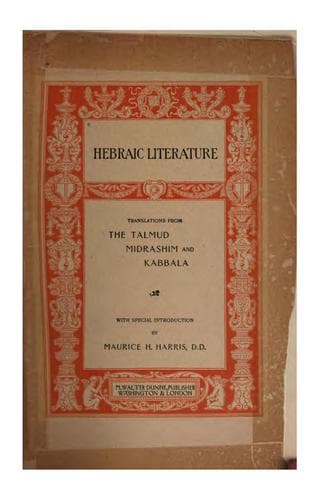
Hebraic Literature; Translations from the Talmud, Midrashim and Kabbala
Religion
Hebraic Literature; Translations from the Talmud, Midrashim and Kabbala
Hebrew literature -- Translations into English
There was once a dispute between Rabbi Eliezer and the Mishnic sages as
to whether a baking-oven, constructed from certain materials and of a
particular shape, was clean or unclean. The former decided that it was
clean, but the latter were of a contrary opinion. Having replied to all
the objections the sages had brought against his decision, and finding
that they still refused to acquiesce, the Rabbi turned to them and said,
"If the Halacha (the law) is according to my decision, let this
carob-tree attest." Whereupon the carob-tree rooted itself up and
transplanted itself to a distance of one hundred, some say four hundred,
yards from the spot. But the sages demurred and said, "We cannot admit
the evidence of a carob-tree." "Well, then," said Rabbi Eliezer, "let
this running brook be a proof;" and the brook at once reversed its
natural course and flowed back. The sages refused to admit this proof
also. "Then let the walls of the college bear witness that the law is
according to my decision;" upon which the walls began to bend, and were
about to fall, when Rabbi Joshuah interposed and rebuked them, saying,
"If the disciples of the sages wrangle with each other in the Halacha,
what is that to you? Be ye quiet!" Therefore, out of respect to Rabbi
Joshuah, they did not fall, and out of respect to Rabbi Eliezer they did
not resume their former upright position, but remained toppling, which
they continue to do to this day. Then said Rabbi Eliezer to the sages,
"Let Heaven itself testify that the Halacha is according to my
judgment." And a Bath Kol or voice from heaven was heard, saying, "What
have ye to do with Rabbi Eliezer? for the Halacha is on every point
according to his decision!" Rabbi Joshuah then stood up and proved from
Scripture that even a voice from heaven was not to be regarded, "For
Thou, O God, didst long ago write down in the law which Thou gavest on
Sinai (Exod. xxiii. 2), 'Thou shalt follow the multitude.'" (See
context.) We have it on the testimony of Elijah the prophet, given to
Rabbi Nathan, on an oath, that it was with reference to this dispute
about the oven God himself confessed and said, "My children have
vanquished me! My children have vanquished me!"
_Bava Metzia_ fol. 59, col. 1.
In the sequel to the above we are told that all the legal
documents of Rabbi Eliezer containing his decisions respecting
things "clean" were publicly burned with fire, and he himself
excommunicated. In consequence of this the whole world was
smitten with blight, a third in the olives, a third in the
barley, and a third in the wheat; and the Rabbi himself, though
excommunicated, continued to be held in the highest regard in
Israel.
Public-domain text, read in full here on John Shaqi.
Reviews
Reviews
No reviews yet
Be the first to share your thoughts on this work.
Elsewhere in the archive
Join the Discussion
Join the discussion
Sign in to leave a comment or review.
Sign InorCreate an account