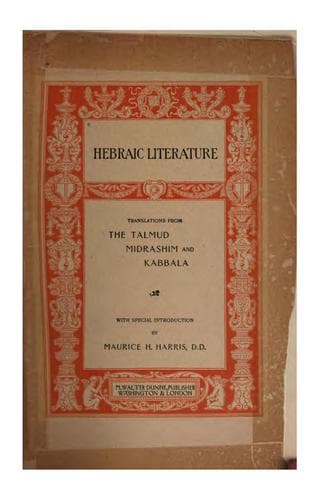
Hebraic Literature; Translations from the Talmud, Midrashim and Kabbala
Religion
Hebraic Literature; Translations from the Talmud, Midrashim and Kabbala
Hebrew literature -- Translations into English
Cæsar once said to Rabbi Yoshua ben Chananja, "This God of yours is
compared to a lion, as it is written (Amos iii. 8), 'The lion hath
roared, who will not fear?' Wherein consists his excellency? A horseman
kills a lion." The Rabbi replied, "He is not compared to an ordinary
lion, but to a lion of the forest Ilaei." "Show me that lion at once,"
said the Emperor. "But thou canst not behold him," said the Rabbi. Still
the Emperor insisted on seeing the lion; so the Rabbi prayed to God to
help him in his perplexity. His prayer was heard; the lion came forth
from his lair and roared, upon which, though it was four hundred miles
away, all the walls of Rome trembled and fell to the ground. Approaching
three hundred miles nearer, he roared again, and this time the teeth of
the people dropped out of their mouths and the Emperor fell from his
throne quaking. "Alas! Rabbi, pray to thy God that He order the lion
back to his abode in the forest."
_Chullin_, fol. 59, col. 2.
All this is as nothing compared to the voice of Judah, which
made all Egypt quake and tremble, and Pharaoh fall from his
throne headlong, etc., etc. See Jasher, chap. 64, verses 46, 47.
The distance from the earth to the firmament is five hundred years'
journey, and so it is from each successive firmament to the next,
throughout the series of the seven heavens.
_P'sachim_, fol. 94, col. 2.
"Now, as I beheld the living creatures, behold, one wheel upon the earth
by the living creatures" (Ezek. i. 15). Rabbi Elazar says it was an
angel who stood upon the earth, and his head reached to the living
creatures. It is recorded in a Mishna that his name is Sandalphon, who
towers above his fellow-angels to a height of five hundred years'
journey; he stands behind the chariot and binds crowns on the head of
his Creator.
_Chaggigah_, fol. 13, col. 2.
In the Liturgy for the Feast of Tabernacles it is said that
Sandalphon gathers in his hands the prayers of Israel, and,
forming a wreath of them, he adjures it to ascend as an orb for
the head of the supreme King of kings.
The mount of the Temple was five hundred yards square.
_Middoth_, chap. 2.
One Scripture text (1 Chron. xxi. 25) says, "So David gave to Ornan for
the place six hundred shekels of gold by weight." And another Scripture
(2 Sam. xxiv. 24) says, "So David bought the threshing-floor and the
oxen for fifty shekels of silver." How is this? David took from each
tribe fifty shekels, and they made together the total six hundred, i.e.,
he took silver to the value of fifty shekels of gold.
_Zevachim_, fol. 116, col. 2.
Public-domain text, read in full here on John Shaqi.
Reviews
Reviews
No reviews yet
Be the first to share your thoughts on this work.
Elsewhere in the archive
Join the Discussion
Join the discussion
Sign in to leave a comment or review.
Sign InorCreate an account