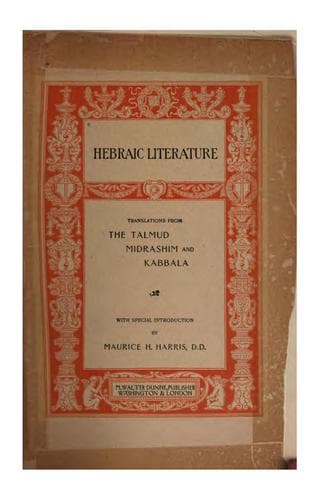
Hebraic Literature; Translations from the Talmud, Midrashim and Kabbala
Religion
Hebraic Literature; Translations from the Talmud, Midrashim and Kabbala
Hebrew literature -- Translations into English
Rabbi Samlai explains that six hundred and thirteen commandments were
communicated to Moses; three hundred and sixty-five negative, according
to the number of days in the year, and two hundred and forty-eight
positive, according to the number of members in the human body. Rav
Hamnunah asked what was the Scripture proof for this. The reply was
(Deut. xxxiii. 4), "Moses commanded us a law" (Torah), which by Gematria
answers to six hundred and eleven. "I am," and "Thou shalt have no
other," which we heard from the Almighty Himself, together make up six
hundred and thirteen.
_Maccoth_, fol. 23, col. 2.
David, we are told, reduced these commandments here reckoned at
six hundred and thirteen, to eleven, and Isaiah still further to
six, and then afterward to two. "Thus saith the Eternal, Observe
justice and act righteously, for my salvation is near." Finally
came Habakkuk, and he reduced the number to one
all-comprehensive precept (chap. ii. 4), "The just shall live by
faith." (See _Maccoth_, fol. 24, col. 1.)
The precept concerning fringes is as weighty as all the other precepts
put together; for it is written, says Rashi (Num. xv. 39), "And remember
all the commandments of the Lord." Now the numerical value of the word
"fringes" is six hundred, and this with eight threads and five knots
makes six hundred and thirteen.
_Shevuoth_, fol. 29, col. 1.
"For behold, the Lord, the Lord of hosts, doth take away from Jerusalem
and from Judah the stay and the staff, the whole stay of bread and the
whole stay of water, the mighty man and the man of war, the judge and
the prophet," etc. (Isa. iii. 1, 2). By "the stay" is meant men mighty
in the Scriptures, and by "the staff" men learned in the Mishna; such,
for instance, as Rabbi Yehudah ben Tima and his associates. Rav Pappa
and the Rabbis differed as to the Mishna; the former said there were six
hundred orders of the Mishna, and the latter that there were seven
hundred orders. "The whole stay of bread" means men distinguished in the
Talmud; for it is said, "Come, eat of my bread, and drink of the wine
which I have mingled" (Prov. ix. 5). And "the whole stay of water" means
men skillful in the Haggadoth, who draw out the heart of man like water
by means of a pretty story or legend, etc.
_Chaggigah_, fol. 14, col. 1.
There are seven hundred species of fish, eight hundred of locusts,
twenty-four of birds that are unclean, while the species of birds that
are clean cannot be numbered.
_Chullin_, fol. 63, col. 2.
"The same was Adino the Eznite," etc. (2 Sam. xxiii. 8). This mighty man
when studying the law was as pliant as a worm; but when engaged in war
he was as firm and unyielding as a tree; and when he discharged an arrow
he killed eight hundred men at one shot.
_Moed Katon_, fol. 16, col. 2.
"Ye shall soon utterly perish from off the land" (Deut. iv. 26). The
term soon uttered by the Lord of the Universe means eight hundred and
fifty-two years.
Public-domain text, read in full here on John Shaqi.
Reviews
Reviews
No reviews yet
Be the first to share your thoughts on this work.
Elsewhere in the archive
Join the Discussion
Join the discussion
Sign in to leave a comment or review.
Sign InorCreate an account