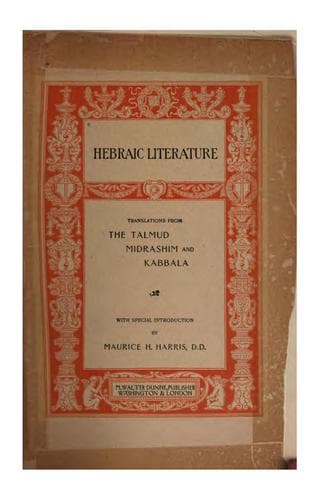
Hebraic Literature; Translations from the Talmud, Midrashim and Kabbala
Religion
Hebraic Literature; Translations from the Talmud, Midrashim and Kabbala
Hebrew literature -- Translations into English
It is related by the Rabbis that Rabbon Yochanan ben Zacchai was once
riding out of Jerusalem accompanied by his disciples, when he saw a
young woman picking barley out of the dung on the road. On his asking
her name, she told him that she was the daughter of Nikodemon ben
Gorion. "What has become of thy father's riches?" said he, "and what has
become of thy dowry?" "Dost thou not remember," said she, "that charity
is the salt of riches?" (Her father had not been noted for this virtue.)
"Dost thou not remember signing my marriage contract?" said the woman.
"Yes," said the Rabbi, "I well remember it. It stipulated for a million
gold denarii from thy father, besides the allowance from thy husband,"
etc.
_Kethuboth_, fol. 66, col. 2.
Abba Benjamin says, "If our eye were permitted to see the malignant
sprites that beset us, we could not rest on account of them." Abaii has
said, "They out-number us, they surround us as the earthed-up soil on
our garden-beds." Rav Hunna says, "Every one has a thousand at his left
side and ten thousand at his right" (Ps. xci. 7). Rava adds, "The
crowding at the schools is caused by their pushing in; they cause the
weariness which the Rabbis experience in their knees, and even tear
their clothes by hustling against them. If one would discover traces of
their presence, let him sift some ashes upon the floor at his bedside,
and next morning he will see, as it were, the footmarks of fowls on the
surface. But if one would see the demons themselves, he must burn to
ashes the after-birth of a first-born black kitten, the offspring of a
first-born black cat, and then put a little of the ashes into his eyes,
and he will not fail to see them," etc., etc.
_Berachoth_, fol. 6, col. 1.
In each camp there are suspended three hundred and sixty-five myriads of
stars, etc.
Agrippa, being anxious to ascertain the number of the male population of
Israel, instructed the priest to take accurate note of the Paschal
lambs. On taking account of the kidneys, it was found that there were
sixty myriad couples (which indicated) double the number of those that
came up out of Egypt, not reckoning those that were ceremonially unclean
and those that were out traveling. There was not a Paschal lamb in which
less than ten had a share, so that the number represented over six
hundred myriads of men.
_P'sachim_, fol. 64, col. 2.
"It is unlawful to enumerate Israel even with a view to a
meritorious deed" (_Yoma_, fol. 22, col. 2). From Rashi's
comment on the former text it seems that the priest merely held
up the duplicate kidneys, upon which the king's agent regularly
laid aside a pea or a pebble into a small heap, which were
afterwards counted up. See also Josephus, Book VI. chap. ix.
sec. 3.
Public-domain text, read in full here on John Shaqi.
Reviews
Reviews
No reviews yet
Be the first to share your thoughts on this work.
Elsewhere in the archive
Join the Discussion
Join the discussion
Sign in to leave a comment or review.
Sign InorCreate an account