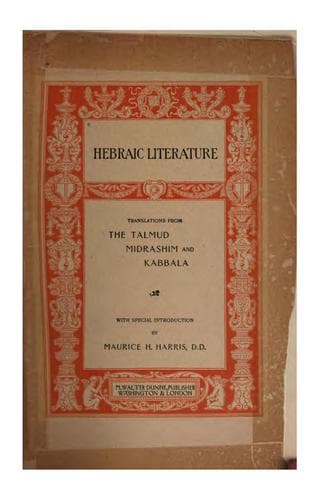
Hebraic Literature; Translations from the Talmud, Midrashim and Kabbala
Religion
Hebraic Literature; Translations from the Talmud, Midrashim and Kabbala
Hebrew literature -- Translations into English
It might not be amiss to remind the reader in passing that if
one were to reckon one hundred per minute for ten hours a day,
it would take no less than sixteen days six hours forty minutes
to count a million; and that it would take twenty men, reckoning
at the same rate, to sum up the total number stated in the text
in one day, so as to ascertain that there were 1,200,000
sacrifices at the Passover under notice, representing no less
than 12,000,000 celebrants.
At the time when Israel in their eagerness first said, "We will do," and
then, "We will hear" (Exod. xxix. 7), there came sixty myriads of
ministering angels to crown each Israelite with two crowns, one for "we
will do" and one for "we will hear." But when after this Israel sinned,
there came down a hundred and twenty myriads of destroying angels and
took the crowns away from them, as it is said (Exod. xxxiii. 6), "And
the children of Israel stripped themselves of their ornaments by Mount
Horeb." Resh Lakish says, "The Holy One--blessed be He!--will, in the
future, return them to us; for it is said (Isa. xxxv. 10), 'The ransomed
of the Lord shall return and come to Zion with songs and everlasting joy
upon their heads,' i.e., the joy they had in days of yore, upon their
heads."
_Shabbath_, fol. 88, col. 1.
Let no one venture out alone at night-time on Wednesdays and Saturdays,
for Agrath, the daughter of Machloth, roams about accompanied by
eighteen myriads of evil genii, each one of which has power to destroy.
_P'sachim_, fol. 112, col. 2.
It is related of Rabbi Elazar ben Charsom that his mother made him a
shirt which cost two myriads of manahs, but his fellow-priests would not
allow him to wear it, because he appeared in it as though he were naked.
_Yoma_, fol. 35, col. 2.
He who has not seen the double gallery of the Synagogue in Alexandria of
Egypt, has not seen the glory of Israel.... There were seventy-one seats
arranged in it according to the number of the seventy-one members of the
greater Sanhedrin, each seat of no less value than twenty-one myriads of
golden talents. A wooden pulpit was in the centre, upon which stood the
reader holding a Sudarium (a kind of flag) in his hand, which he waved
when the vast congregation were required to say Amen at the end of any
benediction, which, of course, it was impossible for all to hear in so
stupendous a synagogue. The congregation did not sit promiscuously, but
in guilds; goldsmiths apart, silversmiths apart, blacksmiths,
coppersmiths, embroiderers, weavers, etc., all apart from each other.
When a poor craftsman came in, he took his seat among the people of his
guild, who maintained him till he found employment. Abaii says all this
immense population was massacred by Alexander of Macedon. Why were they
thus punished? Because they transgressed the Scripture, which says
(Deut. xvii. 16), "Ye shall henceforth return no more that way."
_Succah_, fol. 51, col. 2.
Public-domain text, read in full here on John Shaqi.
Reviews
Reviews
No reviews yet
Be the first to share your thoughts on this work.
Elsewhere in the archive
Join the Discussion
Join the discussion
Sign in to leave a comment or review.
Sign InorCreate an account