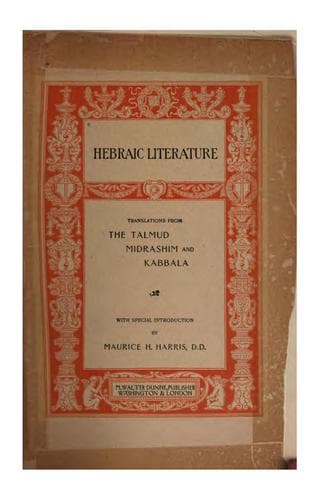
Hebraic Literature; Translations from the Talmud, Midrashim and Kabbala
Religion
Hebraic Literature; Translations from the Talmud, Midrashim and Kabbala
Hebrew literature -- Translations into English
The Rabbis teach that during a prosperous year in the land of Israel, a
place sown with a measure of seed produces five myriad cors (a cor being
equal to thirty measures).
_Kethuboth_, fol. 112, col. 1.
Rav Ulla was once asked, "To what extent is one bound to honor his
father and mother?" To which he replied, "See what a Gentile of Askelon
once did, Dammah ben Nethina by name. The sages one day required goods
to the value of sixty myriads, for which they were ready to pay the
price, but the key of the store-room happened to be under the pillow of
his father, who was fast asleep, and Dammah would not disturb him."
Rabbi Eliezer was once asked the same question, and he gave the same
answer, adding an interesting fact to the illustration: "The sages were
seeking after precious stones for the high priest's breastplate, to the
value of some sixty or eighty myriads of golden denarii, but the key of
the jewel-chest happened to be under the pillow of his father, who was
asleep at the time, and he would not wake him. In the following year,
however, the Holy One--blessed be He!--rewarded him with the birth of a
red heifer among his herds, for which the sages readily paid him such a
sum as compensated him fully for the loss he sustained in honoring his
parent."
_Kiddushin_, fol. 31, col. 1.
"The Lord hath swallowed up all the habitations of Jacob" (Lam. ii. 2).
Ravin came to Babylon and said in the name of Rabbi Yochanan, "These are
the sixty myriads of cities which King Yannai (Jannnæus) possessed on
the royal mount. The population of each equalled the number that went up
out of Egypt, except that of three cities in which that number was
doubled. And these three cities were Caphar Bish (literally, the village
of evil), so called because there was no hospice for the reception of
strangers therein; Caphar Shichlaiim (village of water-cresses), so
called because it was chiefly on that herb that the people subsisted;
Caphar Dichraya (the village of male children), so called, says Rabbi
Yochanan, because its women first gave birth to boys, and afterward to
girls, and then left off bearing." Ulla said, "I have seen that place,
and am sure that it could not hold sixty myriads of sticks." A Sadducee
upon this said to Rabbi Chanina, "Ye do not speak the truth." The
response was, "It is written (Jer. iii. 19), 'The inheritance of a
deer,' as the skin of a deer, unoccupied by the body of the animal,
shrinks, so also the land of Israel, unoccupied by its rightful owners,
became contracted."
_Gittin_, fol. 57, col. 1.
Public-domain text, read in full here on John Shaqi.
Reviews
Reviews
No reviews yet
Be the first to share your thoughts on this work.
Elsewhere in the archive
Join the Discussion
Join the discussion
Sign in to leave a comment or review.
Sign InorCreate an account