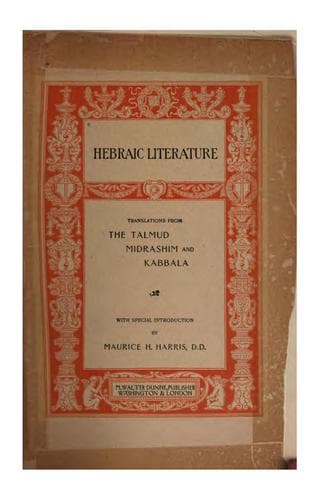
Hebraic Literature; Translations from the Talmud, Midrashim and Kabbala
Religion
Hebraic Literature; Translations from the Talmud, Midrashim and Kabbala
Hebrew literature -- Translations into English
Esau said, "I will not kill my brother Jacob with bow and arrow, but
with my mouth I will suck his blood," as it is said (Gen. xxxiii. 4),
"And Esau ran to meet him, and embraced him, and kissed him, and they
wept." Read not "and he kissed him," but read, "and he bit him." The
neck of Jacob, however, became as hard as ivory, and it is respecting
him that Scripture says (Cant. vii. 5), "Thy neck is as a tower of
ivory,"--so that the teeth of Esau became blunted; and when he saw that
his desire could not be gratified, he began to be angry, and gnashed his
teeth, as it is said (Ps. cxii. 10), "The wicked shall see it and be
grieved; he shall gnash with his teeth."
_Pirke d'Rab. Eliezer_, chap. 36.
See also the previous quotation from the Midrash Rabbah. The
Targum of Jonathan and also the Yerushalmi record the same
fantastic tradition. In the latter it is given thus, "And Esau
ran to meet him, and hugged him, and fell upon his neck and
kissed him. Esau wept for the crushing of his teeth, and Jacob
wept for the tenderness of his neck."
Abraham made a covenant with the people of the land, and when the angels
presented themselves to him, he thought they were mere wayfarers, and he
ran to meet them, purposing to make a banquet for them. This banquet he
told Sarah to get prepared, just as she was kneading cakes. For this
reason he did not offer them the cakes which she had made, but "ran to
fetch a calf, tender and good." The calf in trepidation ran away from
him and hid itself in the cave of Machpelah, into which he followed it.
Here he found Adam and Eve fast asleep, with lamps burning over their
couches, and the place pervaded with a sweet-smelling odor. Hence the
fancy he took to the cave of Machpelah for a "possession of a
burying-place."
Ibid.
Shechem, the son of Hamor, assembled girls together playing on
tambourines outside the tent of Dinah, and when she "went out to see
them," he carried her off, ... and she bare him Osenath. The sons of
Jacob wished to kill her, lest the people of the land should begin to
talk scandal of the house of their father. Jacob, however, engraved the
holy Name on a metal plate, suspended it upon her neck, and sent her
away. All this being observed before the Holy One--blessed be He!--the
angel Michael was sent down, who led her to Egypt, into the house of
Potipherah; for Osenath was worthy to become the wife of Joseph.
_Pirke d'Rab. Eliezer_, chap. 48.
In Yalkut Yehoshua 9, Osenath is styled a proselyte; and indeed
it might seem likely enough that Joseph induced her to worship
the true God. The Targum of Jonathan agrees with the version of
the Midrash above, while another tradition makes Joseph marry
Zuleika, the virgin widow of Potiphar, and says that she was the
same woman that is called Osenath (_Koran_, note to p. 193).
Public-domain text, read in full here on John Shaqi.
Reviews
Reviews
No reviews yet
Be the first to share your thoughts on this work.
Elsewhere in the archive
Join the Discussion
Join the discussion
Sign in to leave a comment or review.
Sign InorCreate an account