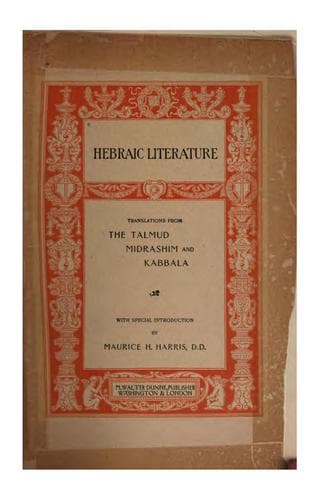
Hebraic Literature; Translations from the Talmud, Midrashim and Kabbala
Religion
Hebraic Literature; Translations from the Talmud, Midrashim and Kabbala
Hebrew literature -- Translations into English
When Joseph's brethren recognized him, and were about to kill him, an
angel came down and dispersed them to the four corners of the house.
Then Judah screamed with such a loud voice that all the walls of Egypt
were leveled with the dust, all the beasts were smitten to the ground,
and Joseph and Pharaoh, their teeth having fallen out, were cast down
from their thrones; while all the men that stood before Joseph had their
heads twisted round with their faces toward their backs, and so they
remained till the day of their death; as it is said (Job iv. 10), "The
roaring of the lion (Judah), and the voice of the fierce lion," etc.
_Vayegash_, chap. 5.
The tradition of a legend in our possession says that Judah killed Esau.
When? When Isaac died, Jacob and (the chiefs of) the twelve clans went
to bury him; as it is written (Gen. xxxv. 29), "And his sons Esau and
Jacob buried him." In the Midrash it is, "And Esau and Jacob and his
sons buried him," which fits the legend better. Arrived at the cave,
they entered it, and they stood and wept. The (heads of the) tribes, out
of respect to Jacob, left the cave, that Jacob might not be put to shame
in their presence. Judah re-entered it, and finding Esau risen up as if
about to murder Jacob, he instantly went behind him and killed him. But
why did he not kill him from the front? Because the physiognomy of Esau
was exactly like that of Jacob, and it was out of respect to the latter
that he slew Esau from behind.
_Midrash Shochar Tov_, chap. 18.
Tradition varies respecting the tragic end of Esau. The Book of
Jasher (chap. 56, v. 64) and the Targum of Jonathan (in Vayechi)
both say that Cushim the son of Dan slew Esau at the burial, not
of Isaac, but of Jacob, because he sought to hinder the funeral
obsequies, disputing the title to the sepulchre.
"Oh, that I had wings like a dove! for then I would fly away, and be at
rest" (Ps. lv. 6). This is spoken of Abraham. But why like a dove? Rabbi
Azariah, in the name of Rabbi Yudan, says, "Because all birds when tired
rest on a rock or on a tree, but a dove, when tired of flying, draws in
one wing to rest it, and continues her flight with the other."
_Bereshith Rabbah_, chap. 39.
The Holy One--blessed be He!--said unto Abraham, "What should I tell
thee? and with what shall I bless thee? Shall I tell thee to be
perfectly righteous, or that thy wife Sarah be righteous before me? That
ye both are already. Or shall I say that thy children shall be
righteous? They are so already. But I will bless thee so that all thy
children which shall in future ages come forth from thee shall be just
like thee." Whence do we learn this? From Gen xv. 5: "And he said unto
him, So (like thee) shall thy seed be."
_Bamidbar Rabbah_, chap. 2.
Public-domain text, read in full here on John Shaqi.
Reviews
Reviews
No reviews yet
Be the first to share your thoughts on this work.
Elsewhere in the archive
Join the Discussion
Join the discussion
Sign in to leave a comment or review.
Sign InorCreate an account