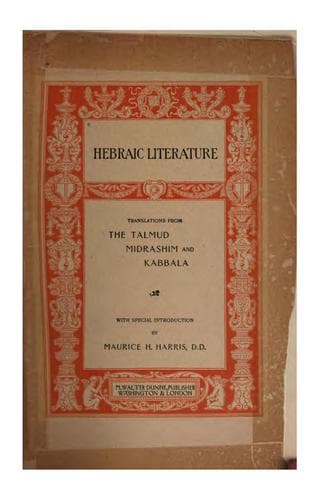
Hebraic Literature; Translations from the Talmud, Midrashim and Kabbala
Religion
Hebraic Literature; Translations from the Talmud, Midrashim and Kabbala
Hebrew literature -- Translations into English
Rabbi Samlai said to Rabbi Yonathan, "Instruct me in the Aggada." The
latter replied, "We have a tradition from our forefathers not to
instruct either a Babylonian or a Daromean in the Aggada, for though
they are deficient in knowledge they are haughty in spirit."
_Tal. Yerushalmi P'sachim_, v. fol. 32, col. 1.
He who transcribes the Aggada has no portion in the world to come; he
who expounds it is excommunicated; and he who listens to the exposition
of it shall receive no reward.
_Tal. Yerushalmi P'sachim, Shabbath_, xvi. fol. 30, col. 2.
"Day unto day uttereth speech" (Ps. xix. 2, 3, 4); this means the Law,
the Prophets, and the Hagiographa. "And night unto night showeth
knowledge;" this is the Mishnaioth. "There is no speech or language
where their voice is not heard;" these are the Halachoth. "Their line is
gone out through all the earth;" these are the Aggadoth, by which His
great name is sanctified.
_T. debei Aliahu_, chap. 2.
Rabbi Yeremiah, the son of Elazar, said, "When the Holy One--blessed be
He!--created Adam, He created him an androgyne, for it is written (Gen.
v. 2), 'Male and female created He them.'" Rabbi Sh'muel bar Nachman
said, "When the Holy One--blessed be He!--created Adam, He created him
with two faces; then He sawed him asunder, and split him (in two),
making one back to the one-half, and another to the other."
_Midrash Rabbah_, chap. 8.
"And it repented the Lord that He had made man (Adam) on the earth, and
it grieved Him at His heart" (Gen. vi. 6). Rabbi Berachiah says that
when God was about to create Adam, He foresaw that both righteous people
and wicked people would come forth from him. He reasoned therefore with
Himself thus: "If I create him, then will the wicked proceed from him;
but if I do not create him, how then shall the righteous come forth?"
What then did God do? He separated the ways of the wicked from before
Him, and assuming the attribute of mercy, so He created him. This
explains what is written (Ps. i. 6), "For the Lord knoweth the way of
the righteous, but the way of the wicked shall be lost." The way of the
wicked was lost before Him, but assuming to Himself the attribute of
mercy, He created him. Rabbi Chanina says, "It was not so! But when God
was about to create Adam, He consulted the ministering angels and said
unto them (Gen. i. 26), 'Shall we make man in our image after our
likeness?' They replied, 'For what good wilt thou create him?' He
responded, 'That the righteous may rise out of him.' This explains what
is written, 'For the Lord knoweth the way of the righteous, but the way
of the wicked shall be lost.' God informed them only about the
righteous, but He said nothing about the wicked, otherwise the
ministering angels would not have given their consent that man should be
created."
_Bereshith Rabbah_, chap. 8.
Public-domain text, read in full here on John Shaqi.
Reviews
Reviews
No reviews yet
Be the first to share your thoughts on this work.
Elsewhere in the archive
Join the Discussion
Join the discussion
Sign in to leave a comment or review.
Sign InorCreate an account