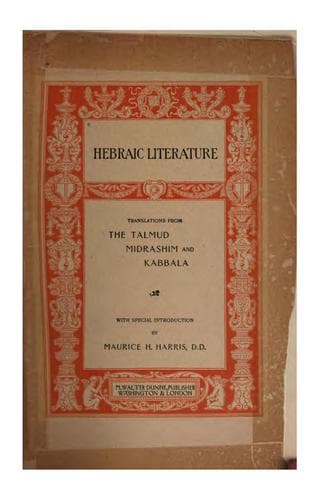
Hebraic Literature; Translations from the Talmud, Midrashim and Kabbala
Religion
Hebraic Literature; Translations from the Talmud, Midrashim and Kabbala
Hebrew literature -- Translations into English
A Gentile once asked Rabbi Yoshua ben Kapara, "Is it true that ye say
your God sees the future?" "Yes," was the reply. "Then how is it that it
is written (Gen. vi. 6), 'And it grieved Him at His heart'?" "Hast
thou," replied the Rabbi, "ever had a boy born to thee?" "Yes," said the
Gentile; "and I rejoiced and made others rejoice with me." "Didst thou
not know that he would eventually die?" asked the Rabbi. "Yes," answered
the other; "but at the time of joy is joy, and at the time of mourning,
mourning." "So it is before the Holy One--blessed be He!--seven days He
mourned before the deluge destroyed the world."
_Bereshith Rabbah_, chap. 27.
All the strength of the soul's mourning is from the third to the
thirtieth day, during which time she sits on the grave, still thinking
her beloved might yet return (to the body whence she departed). When she
notices that the color of the face is changed, she leaves and goes away;
and this is what is written (Job. xiv. 22), "But his flesh upon him
shall have pain, and his soul shall mourn over him." Then the mouth and
the belly quarrel with one another, the former saying to the latter,
"All I have robbed and taken by violence I deposited in thee;" and the
latter, having burst three days after its burial, saying to the former,
"There is all thou hast robbed and taken by violence! as it is written
(Eccles. xii. 6), 'The pitcher is broken at the fountain.'"
Ibid., chap. 100.
Job said, "Even the devil shall not dissuade me from comforting those
that mourn; for I would tell him that I am not better than my Creator,
who comforts Israel; as it is said (Isa. li. 12), 'I, even I, am He that
comforteth you.'"
_Psikta Nachmu._
Once Rabbi Shimon ben Yehozedek addressed Rabbi Sh'muel ben Nachman and
said, "I hear that thou art a Baal Aggadah; canst thou therefore tell me
whence the light was created?" "We learn," he replied in a whisper,
"that God wrapped Himself with light as with a garment, and He has
caused the splendor thereof to shine from one end of the world to the
other." The other said, "Why whisperest thou, I wonder, since Scripture
says so plainly (Ps. civ. 2) 'Who covereth Himself with light as with a
garment'?" The reply was, "I heard it in a whisper, and in a whisper I
have told it to thee."
_Bereshith Rabbah_, chap. 3.
"As the tents of Kedar" (Cant. i. 5). As the tents of the Ishmaelites
are ugly without and comely within, so also the disciples of the wise,
though apparently wanting in beauty, are nevertheless full of Scripture,
and of the Mishnah and of the Talmud, of the Halacha and of the
Aggadoth.
_Shemoth Rabbah_, chap. 23.
"Write thou these words" (Exod. xxxiv. 37). That applies to the Law, the
Prophets, and the Hagiographa, which were given in writing, but not to
the Halachoth, the Midrashim, the Aggadoth, and the Talmud, which were
given by the mouth.
Ibid., chap. 47.
Public-domain text, read in full here on John Shaqi.
Reviews
Reviews
No reviews yet
Be the first to share your thoughts on this work.
Elsewhere in the archive
Join the Discussion
Join the discussion
Sign in to leave a comment or review.
Sign InorCreate an account