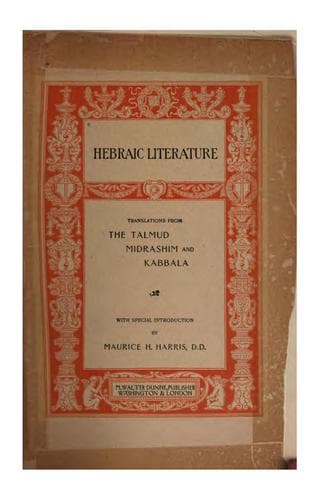
Hebraic Literature; Translations from the Talmud, Midrashim and Kabbala
Religion
Hebraic Literature; Translations from the Talmud, Midrashim and Kabbala
Hebrew literature -- Translations into English
"Unto Adam and his wife did the Lord God make coats of skins" (Gen. iii.
21), viz, to cover their nakedness; but with what? With fringes and
phylacteries, "Coats of skins," viz, the leathern straps of the
phylacteries; "and they sewed fig-leaves" (Gen. iii. 7), viz, fringes;
"and made themselves aprons," this means the proclaiming of the Shema,
"Hear, O Israel," etc.
_Yalkut Chadash._
The aprons, which some (as Rashi, for instance) take to denote
furs, the Targum of Jonathan says were made "from the skin of
the serpent." The wardrobe of Adam afterward came into the
possession of Esau and Jacob (see Targ. Yon. in Toledoth, and p.
199, No. 161, _ante_).
All the presents which our father Jacob gave to Esau will one day be
returned by the nations of the world to the Messiah, and the proof of
this is (Ps. lxxii. 10), "The kings of Tarshish and the isles shall
return presents." It is not written here, "They shall bring," but they
shall restore or return.
_Midrash Rabbah Vayishlach_, chap. 78.
A philosopher once posed Rabbi Eliezer with the question, "Does not the
prophet say (Mal. i. 4), 'They shall build, but I will throw down'? and
do not buildings still exist?" To which the Rabbi answered, "The prophet
does not speak of buildings, but of the schemes of designers. Ye all
think to contrive and build up devices, to destroy and make an end of
us, but He bringeth your counsels to nought. He throweth them down, so
that your devices against us have no effect." "By thy life," said the
philosopher, "it is even so; we meet annually for the purpose of
compassing your ruin, but a certain old man comes and upsets all your
projects" (namely, Elijah).
_Yalkut Malachi._
When Israel came out of Egypt, Samael rose to accuse them, and thus he
spoke: "Lord of the Universe! these have till now worshiped idols, and
art Thou going to divide the sea for such as they?" What did the Holy
One--blessed be He!--then do? Job, one of Pharaoh's high counselors, of
whom it is written (Job i. 1), "That man was perfect and upright," He
took and delivered to Samael, saying, as He did so, "Behold, he is in
thy hand; do with him as thou pleasest." God thought to divert his evil
designs by keeping him thus occupied with Job, that Israel meanwhile
might cross the sea without any hindrance, after which He would return
and rescue Job from his tender mercies. God then said to Moses, "Behold
I have delivered Job to Satan; make haste. Speak unto the children of
Israel that they go forward" (Exod. xiv. 15).
_Midrash Rabbah Shemoth_, chap. 21.
No man ever received a mite (in charity) from Job, and needed to receive
such a second time (because of the good-luck it brought along with it).
Ibid.
Public-domain text, read in full here on John Shaqi.
Reviews
Reviews
No reviews yet
Be the first to share your thoughts on this work.
Elsewhere in the archive
Join the Discussion
Join the discussion
Sign in to leave a comment or review.
Sign InorCreate an account