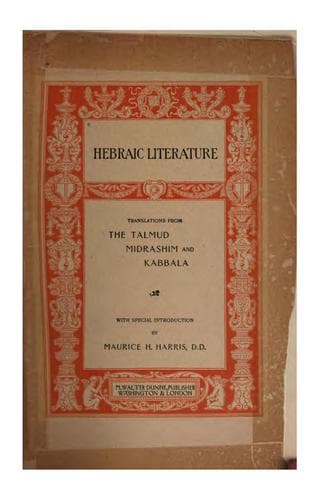
Hebraic Literature; Translations from the Talmud, Midrashim and Kabbala
Religion
Hebraic Literature; Translations from the Talmud, Midrashim and Kabbala
Hebrew literature -- Translations into English
When Solomon brought the ark into the Temple and said, "Lift up your
heads, O ye gates! and the King of glory shall come in," the gates were
ready to fall upon him and crush his head, and they would have done so
if he had not said at once, "The Lord of hosts, He is the King of glory"
(Ps. xxiv. 9, 10). The Holy One--blessed be He!--then said to the gates,
"Since ye have thus honored Me, by your lives! when I destroy My Temple,
no man shall have dominion over you!" This was to inform us that while
all the vessels of the Temple were carried into captivity, the gates of
the Temple were stored away on the very spot where they were erected;
for it is said (Lam. ii. 9), "Her gates are sunk into the ground."
_Midrash Rabbah Devarim_, chap. 15.
We are reminded of this tradition in the conclusion service for
Yom Kippur, where we repeat, "Speedily thou shalt open the
hidden gates to those who hold fast Thy law." The allusion is to
"the gates of the Temple," which "are supposed to be sunk in the
ground."
Rabbi Akiva once met on a journey a remarkably ugly man toiling along
under a great load of wood. Rabbi Akiva said unto him, "I adjure thee to
tell me whether thou art a man or a demon." "Rabbi," said he, "I was
once a man, and it is now some time since I left the world. Day after
day I have to carry a load like this, under which I am obliged to bow
down, and submit three times a day to be burned." Then Rabbi Akiva asked
him, "What was the reason of this punishment?" and the reply was, "I
committed an immorality on the Day of Atonement." The Rabbi asked him if
he knew of anything by which he might obtain for him a remission of his
punishment. "I do," was the answer. "When a son whom I have left behind
me is called up to the (public) reading of the law, and shall say,
'Blessed be the blessed Lord,' I shall be drawn out of hell and taken
into Paradise." The Rabbi noted down the name of the man and his
dwelling-place, whither he afterward went and made inquiries about him.
The people of the place only replied, "The name of the wicked shall rot"
(Prov. x. 7). Notwithstanding this, the Rabbi insisted, and said, "Bring
his son to me." When they brought him, he taught the lad to repeat the
blessing, which he did on the ensuing Sabbath at the public reading of
the law; upon which his father was immediately removed from hell to
Paradise. On the self-same night the father repaired direct to Rabbi
Akiva, and gratefully expressed his hope that the Rabbi's mind might be
as much at rest as his own was.
_Midrash Assereth Hadibroht._
There are three things which a man does not wish for: Grass to grow up
among his grain-crops; to have a daughter among his children; or that
his wine should turn to vinegar. Yet all these three are ordained to be,
for the world stands in need of them. Therefore it is said, "O Lord, my
God, Thou art very great!... He causeth the grass to grow for the
cattle" (Ps. civ. 1, 14)
_Midrash Tanchuma._
Public-domain text, read in full here on John Shaqi.
Reviews
Reviews
No reviews yet
Be the first to share your thoughts on this work.
Elsewhere in the archive
Join the Discussion
Join the discussion
Sign in to leave a comment or review.
Sign InorCreate an account