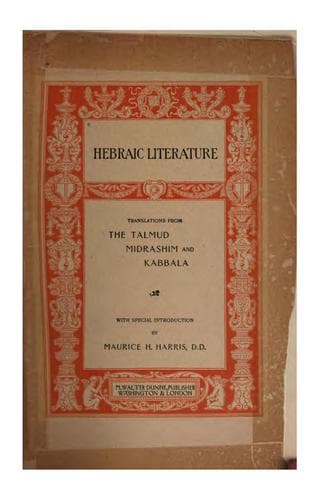
Hebraic Literature; Translations from the Talmud, Midrashim and Kabbala
Religion
Hebraic Literature; Translations from the Talmud, Midrashim and Kabbala
Hebrew literature -- Translations into English
"He stood and measured the earth" (Hab. iii. 6). Rabbi Shimon ben Yochai
expounded "He stood and measured" thus: "The Holy One--blessed be
He!--measured all the nations, and He found none worthy to receive the
law except the generation in the wilderness. He measured all the
mountains, and He found none on which to give the law except Mount
Sinai. He measured all cities, and found none in which to build the
Temple except Jerusalem. He measured all lands, and found none worthy to
be given unto Israel except the one now called the land of Israel. This
it is that is written, 'He stood up and measured the earth.'"
_Vayekra Rabbah_, chap. 13.
"I went down to the bottoms of the mountains" (Jonah ii. 6). From this
we learn that Jerusalem is situated on seven hills. The world's
"foundation-stone" sank to "the depths" under the Temple of the Lord,
and upon this the sons of Korah stand and pray. (They) pointed this out
to Jonah. The fish said unto him, "Jonah, behold thou art standing under
the Temple of the Lord; therefore pray, and thou shalt be answered."
_Pirke d'Rab. Eliezer_, chap. 10.
"And there went out fire from the Lord" (Lev. x. 2). Abba Yossi saith,
"Two threads of fire came out from the Holy of holies, and these were
disparted into four: two entered the nostrils of the one (i.e., Nadab),
and two entered the nostrils of the other (i.e., Abihu), and thus
consumed them. Their souls were burned, but not their garments; for it
is said, 'So they went near, and carried them in their coats'" (ver. 5).
_Torath Cohanim_, sec. _Shemini_.
Rabbi Jacob teaches that he who has no wife abideth without good,
without help, without joy, without blessing or atonement, to which Rabbi
Yehoshua ben Levi adds, (yea) also without peace or life. Rabbi Cheya
says that he is not a perfect man, for it is said, "And blessed them and
called their name man" (Gen. v. 2), where both are spoken of together as
one man.
_Midrash Rabbah Bereshith_, chap. 17.
"My beloved is like a roe" (1 Cant. ii. 9). As a roe leaps and skips
from bush to bush, from covert to covert, from hedge to hedge, so
likewise does the Holy One--blessed be He!--pass from synagogue to
synagogue, and from academy to academy, that He may bless Israel.
_Pesikta._
(Cant. v. 1), "I came into My garden," the synagogues and academies; "My
sister, My spouse," the congregation of Israel; "I have gathered My
myrrh with My spice," the Bible (that is); "I have eaten My honeycomb
with My honey" (this means) the Halachoth, Midrashoth, and Aggadoth; "I
have drank My wine with My milk," this alludes to the good works which
are reserved for the sages of Israel. After that, "Eat, O friends!
drink, yea, drink freely, O beloved!"
_Yalkut Eliezer_, fol. 41, col. 2.
Public-domain text, read in full here on John Shaqi.
Reviews
Reviews
No reviews yet
Be the first to share your thoughts on this work.
Elsewhere in the archive
Join the Discussion
Join the discussion
Sign in to leave a comment or review.
Sign InorCreate an account