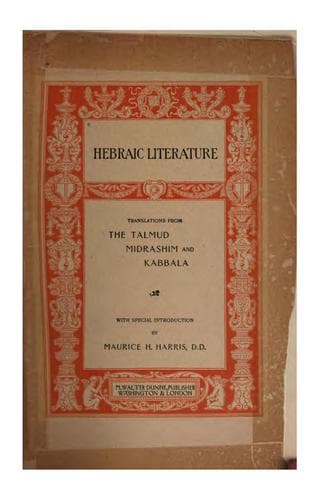
Hebraic Literature; Translations from the Talmud, Midrashim and Kabbala
Religion
Hebraic Literature; Translations from the Talmud, Midrashim and Kabbala
Hebrew literature -- Translations into English
"Her children are gone into captivity before the enemy" (Lam. i. 5).
Rabbi Isaac saith, "Come and see how greatly beloved are the children!"
The Sanhedrin were exiled, but the Shechinah was not exiled with them.
The Temple guards were exiled, but the Shechinah was not exiled with
them. But with the children the Shechinah also was exiled. This is that
which is written (Lam. i. 5, 6), "Her children are gone, ... and from
the daughter of Zion all her beauty (i.e., the Shechinah) is departed."
_Midrash Rabbah Eicha._
"How doth the city sit solitary!" (Lam. i. 1). Three have, in
prophesying, made use of this word "How"--Moses, Isaiah, and Jeremiah.
Moses said (Deut. i. 12), "How can I myself bear your cumbrance!" Isaiah
said (Isa. i. 21), "How is the faithful city become an harlot!" Jeremiah
said (Lam. i. 1), "How doth the city sit solitary!" Rabbi Levi saith,
"The thing is like to a matron who has three friends; one saw her in her
prosperity, another saw her in her dissipation, and the third saw her in
her pollution. So Moses saw Israel in their glory and prosperity, and he
said, 'How can I myself bear your cumbrance!' Isaiah saw them in their
dissipation, and he said, 'How is the faithful city,' etc.; and Jeremiah
saw them in their pollution, and he said, 'How doth the city sit
solitary!'"
_Midrash Rabbah Eicha._
Hezekiah saith the judgment in Gehenna is six months' heat and six
months' cold.
_Midrash Reheh._
Gehenna has sixteen mouths, four toward each cardinal point. The
Gentiles say, "Hell is for Israel, but Paradise is for us." The
Israelites say, "Ours is Paradise."
_Midrash Aggadath Bereshith._
Rabbi Yochanan ben Zachai says, that coming once upon a man who was
gathering wood, he addressed him, but at first he made no reply.
Afterward, however, he came up and said, "Rabbi, I'm not a living man,
but a dead one." "If thou art a dead man," said I, "what is this wood
for?" He replied, "When I was alive upon earth, I and an associate of
mine committed a certain sin in my shop, and when we were taken thence,
we were sentenced to the punishment of mutual burning; so I gather wood
to burn him, and he does the same to burn me." I then asked him, "How
long are you to be punished thus?" He replied, "When I came here my wife
was _enceinte_, and I know she gave birth to a boy. May I beg thee,
therefore, to see that the child is instructed by a teacher, for as soon
as he is able to repeat, 'Bless ye the blessed Lord!' I shall be brought
up hence and be free from this punishment in hell."
_Tanu d'by Eliyahu._
Public-domain text, read in full here on John Shaqi.
Reviews
Reviews
No reviews yet
Be the first to share your thoughts on this work.
Elsewhere in the archive
Join the Discussion
Join the discussion
Sign in to leave a comment or review.
Sign InorCreate an account