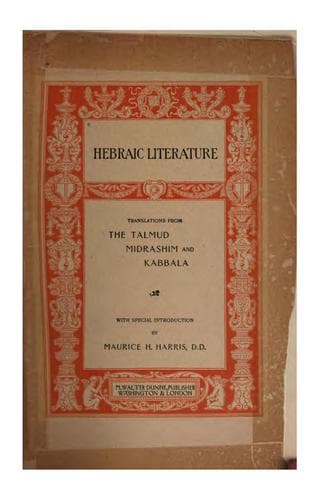
Hebraic Literature; Translations from the Talmud, Midrashim and Kabbala — John Shaqi
Hebraic Literature; Translations from the Talmud, Midrashim and Kabbala
Religion
Hebraic Literature; Translations from the Talmud, Midrashim and Kabbala
Hebrew literature -- Translations into English
Rabbi Berachia saith, "In order that the Minim, apostates, and wicked
Israelites might not escape hell on account of their circumcision, the
Holy One--blessed be He!--sends an angel to undo the effects of it, and
they straightway descend to their doom. When Gehenna sees this, she
opens her mouth and licks them." This is the purport of (Isa. v. 14),
"And she opened her mouth to those without law" (i.e., to those without
the sign of the covenant).
_Midrash Rabbath Shemoth_, chap. 19.
"God hath also set the one over against the other" (Eccles. vii. 14),
i.e., the righteous and the wicked, in order that the one should atone
for the other. God created the poor and the rich, in order that the one
should be maintained by the other. He created Paradise and Gehenna, in
order that those in the one should deliver those in the other. And what
is the distance between them? Rabbi Chanina saith the width of the wall
(between Paradise and Gehenna) is a handbreadth.
_Yalkut Koheleth._
"Those passing through the valley of weeping make it a well; also
blessings shall cover the teacher" (Ps. lxxxiv. 6, A.V.). "The valley of
weeping" is Gehenna. "Make it a well," for their tears are like a well
or spring. "Also blessings shall cover the teacher." Rabbi Yochanan
saith, "The praises of God that ascend from Gehenna are more than those
that ascend from Paradise, for each one that is a step higher than his
neighbor praises God, and says, 'Happy am I that I am a step higher than
the one below me.' 'Also blessings shall cover the teacher,' for they
will acknowledge and say, 'Ye have taught well, and ye have instructed
well, but we have not obeyed.'"
_Yalkut Tehillim_, 84.
Those of the house of Eliyahu have taught that Gehenna is above the sky,
but some say it is behind the mountains of darkness.
_Tanu d'by Eliyahu._
Gehenna was created before Paradise; the former on the second day and
the latter on the third.
_Yalkut_.
In T.B. P'sachim, fol. 54, col. 1, it is said that the reason of
the omission of the words, "And God saw that it was good," in
respect to the second day of the creative week, was because
hell-fire was then created; but see the context.
When Adam saw (through the Spirit) that his posterity would be condemned
to Gehenna, he disobeyed the precept to procreate. But when he perceived
that after twenty-six generations the Israelites would accept the law,
he bestirred himself in compliance; as it is said (Gen. iv. 1), _Adam
vero cognovit uxorem suam Hevam_.
_Yalkut_.
"And the souls they had gotten in Haran" (Gen. xii. 5). These are they
who had been made proselytes. Whoever attracts a Gentile and
proselytizes him is as much as if he had created him. Abraham did so to
men and Sarah to women.
_Bereshith Midrash Rabbah._
Public-domain text, read in full here on John Shaqi.
Reviews
Reviews
No reviews yet
Be the first to share your thoughts on this work.
Elsewhere in the archive
Join the Discussion
Join the discussion
Sign in to leave a comment or review.
Sign InorCreate an account