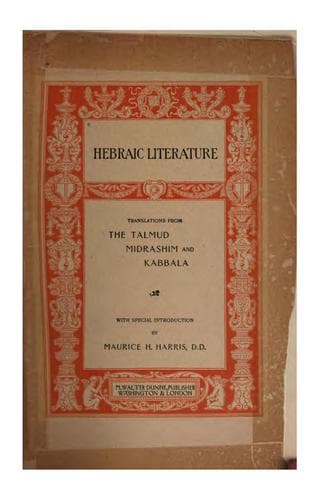
Hebraic Literature; Translations from the Talmud, Midrashim and Kabbala
Religion
Hebraic Literature; Translations from the Talmud, Midrashim and Kabbala
Hebrew literature -- Translations into English
1. "Gematria." This rule depends on the numerical value of each letter
in the alphabet. The application of this rule in the solution of a
disputed point is often such as to show quite as much absurdity as
ingenuity. To make the subject still more clear, let us assume that a
standard numerical value is attached to each letter in the English
alphabet. _A_ has the value of 1, _B_ 2, _C_ 3, _D_ 4, _E_ 5, _F_ 6, _G_
7, _H_ 8, _I_ 9, _J_ 10, _K_ 20, _L_ 30, _M_ 40, _N_ 50, _O_ 60, _P_ 70,
_Q_ 80, _R_ 90, _S_ 100, _T_ 200, _U_ 300, _V_ 400, _W_ 500, _X_ 1000,
_Y_ 10,000, _Z_ 100,000. And let us now assume a point in dispute in
order to illustrate how it is solved by Gematria. Suppose that the
subject of discussion is the comparative superiority of the Hebrew and
English languages, and Hugo and Baruch are the disputants. The former,
being a Hebrew, holds that the Hebrew is superior to the English,
"because," says he, "the numerical value of the letters that form the
word _Hebrew_ is 610; whereas the numerical value of _English_ is only
209." The latter, being an Englishman, holds, of course, exactly the
contrary opinion, and argues as follows: "All the learned world must
admit that the English is a living language, but not so the Hebrew; and
as it is written (Eccles. ix. 4) that 'A living dog is better than a
dead lion,' I therefore maintain that the English is superior to the
Hebrew." The dispute was referred to an Oxford authority for decision,
and a certain learned doctor decided it by--
2. "Notricon." This consists in forming a decisive sentence composed of
words whose initial letters are in a given word; for instance,
_Hebrew_:--"_H_ugo's _e_xcels _B_aruch's _r_easoning _e_very _w_ay."
_English_:--"_E_nglish _n_o _g_ood _l_anguage, _i_s _s_carcely
_h_armonious;" but _Hebrew_:--"_H_oly, _e_legant, _b_rilliant,
_r_esonant, _e_liciting _w_onder!" This is a fair specimen of how to get
at the secret sense of a word by the rule of "Notricon," and now we will
proceed to explain--
3. "Temurah." This means permutation, or a change of the letters of the
alphabet after a regularly adopted system. We know only five such
permuted alphabets, but there may be more. The technical names of these
five alphabets are: "Atbash," "Atbach," "Albam," "Aiakbechar," and
"Tashrak." We will try to explain the first permuted alphabet only, as a
mere specimen, for the general reader is not quite prepared to
comprehend the rest, and a hint for the scholar is sufficient.
Here let the reader observe that as the letters of the English alphabet
are more numerous and differently designated and arranged than those of
the Hebrew, the "Atbash" of the Hebrew must necessarily become "Azby" in
English. If now we write on one line and in regular order the first half
of the alphabet, and the other half on the second line, but in reversed
order, thus:--
a b c d e f g h i j k l m
z y x w v u t s r q p o n
Public-domain text, read in full here on John Shaqi.
Reviews
Reviews
No reviews yet
Be the first to share your thoughts on this work.
Elsewhere in the archive
Join the Discussion
Join the discussion
Sign in to leave a comment or review.
Sign InorCreate an account