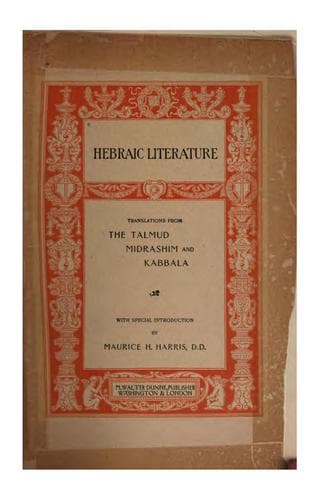
Hebraic Literature; Translations from the Talmud, Midrashim and Kabbala
Religion
Hebraic Literature; Translations from the Talmud, Midrashim and Kabbala
Hebrew literature -- Translations into English
"And Solomon's wisdom excelled" (1 Kings iv. 30). Thou findest that when
Solomon desired to build the Temple he sent to Pharaoh Necho a request
to send him artisans on hire. Pharaoh assembled his astrologers, who
pointed out to him such artisans as were destined to die in the course
of that year, and these he despatched to Solomon; but he, through the
Holy Ghost, seeing the fate that impended, provided each of them with a
shroud and sent them back to Pharaoh with the message, "Hast thou no
shrouds in which to bury thine own dead? Behold here I have provided
them with them!" "For he was wiser than all men" (1 Kings iv. 31); "than
all men," even than the first man, Adam.
_Yalkut Eliezer_, fol. 65, col. 2, n. 36.
"Ye are My witnesses, saith the Lord, that I am God" (Isa. xliii. 12).
Rabbi Shimon ben Yochai expounds these words thus, "If ye are My
witnesses, then I am God; but if ye are not My witnesses, then I am not
God."
_Yalkut Jethro_, n. 271.
"Let us hear the conclusion of the whole matter" (Eccles. xii. 13). Thou
shalt ever hear the Law, even when thou dost not understand it. "Fear
God," and give thy heart to Him. "And keep His commandments," for on
account of the Law the whole world was created, that the world should
study it.
_Koheleth, as given in Tse-enah Ure-enah._
THE KABBALA
"The words of the wise and their dark sayings" (Prov. i. 6).
INTRODUCTORY NOTE
The Hebrew word Kabbal means "to receive," and its derivative, Kabbalah,
signifies, "a thing received," viz, "Tradition," which, together with
the written law, Moses received on Mount Sinai, and we are told in the
Talmud, Rosh Hashanah, fol. 19, col. 1, i.e., "The words of the Kabbalah
are just the same as the words of the law." In another part of this work
we have seen that the Rabbis declare the Kabbalah to be above the law.
The Kabbalah is divided into two parts, viz, the symbolical and the
real.
THE SYMBOLICAL KABBALAH
This teaches the secret of mystic sense of Scripture, and the thirteen
rules by which the observance of the law is, not logically, but
Kabbalistically expounded; viz, the rules of "Gematria," of "Notricon,"
of "Temurah," etc. To give some idea of this kind of exposition, we will
explain each of these three rules in a manner which, though in the style
of the Rabbis, will easily be understood by the Gentile reader.
Public-domain text, read in full here on John Shaqi.
Reviews
Reviews
No reviews yet
Be the first to share your thoughts on this work.
Elsewhere in the archive
Join the Discussion
Join the discussion
Sign in to leave a comment or review.
Sign InorCreate an account