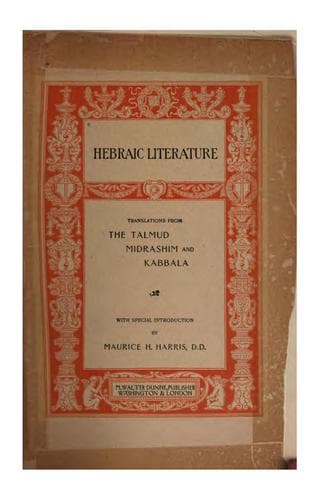
Hebraic Literature; Translations from the Talmud, Midrashim and Kabbala
Religion
Hebraic Literature; Translations from the Talmud, Midrashim and Kabbala
Hebrew literature -- Translations into English
After washing his hands before a meal, he is to stretch out his fingers
and turn the palms of his hands upward, as if in the act of receiving
something from a friend, and then repeat (Ps. cxxxiv. 2), "Lift ye up
your holy hands, and bless ye the Lord!"
Ibid.
The following are the usual blessings, "Blessed art Thou, O
Lord, our God! King of the universe! who has sanctified us with
His commandments, and has commanded us to wash the hands!"
"Blessed art Thou, O Lord, our God! King of the universe! who
bringeth forth bread from the earth!"
By means of combining the letters of the ineffable names, as recorded in
"Book of Creation," Rava once created a man and sent him to Rav Zera.
The man being unable to reply when spoken to, the Rabbi said to him,
"Thou art a creation of the company (initiated in the mysteries of
necromancy); return to thy dust."
_Sanhedrin_, fol. 65, col. 2.
In the Jerusalem Talmud, Sanhedrin, chap. 7, we read that, by
the means above mentioned, a Rabbi created pumpkins, melons, and
real deer and roes.
There is a living creature in heaven which by day has "Truth" upon its
forehead, by which the angels know it is day; but in the evening it has
"Faith" on its forehead, whereby the angels know that night is near.
Each time the living creature says, "Bless ye the blessed Lord," all the
hosts above respond, "Blessed be the blessed Lord forever."
_Kitzur Sh'lh_, fol. 42. col. 2.
Truth and faith are the essentials of religion, which are thirteen in
number:--
1. God exists, and there is no period to His existence. The philosophers
call it absolute existence, but the majority of Kabbalists term it
"endless," which, by Gematria, is "light"; and again, by Gematria, is
"Lord of the Universe." He is the cause of causes and the causing of
causings, and from or by His existence all beings, spiritual and
material, derive their existence.
2. He is one, and there is no unity like His, etc.
3. He has no bodily likeness, and is not corporeal.
4. He is first of everything, absolute beginning; as it is said, "I am
the First and I am the Last" (Isa. xliv 6), and there is no beginning to
His beginning.
5. None but Himself is to be worshiped and prayed to.
6. The gift of prophecy He has given to men esteemed and glorified by
Him.
7. None arose like unto Moses, etc.
8. A law of truth He gave; this is the law from heaven, "In the
beginning" unto "in the sight of all Israel." Also its comment received
orally is likewise "a law (given) unto Moses from Sinai."
Public-domain text, read in full here on John Shaqi.
Reviews
Reviews
No reviews yet
Be the first to share your thoughts on this work.
Elsewhere in the archive
Join the Discussion
Join the discussion
Sign in to leave a comment or review.
Sign InorCreate an account