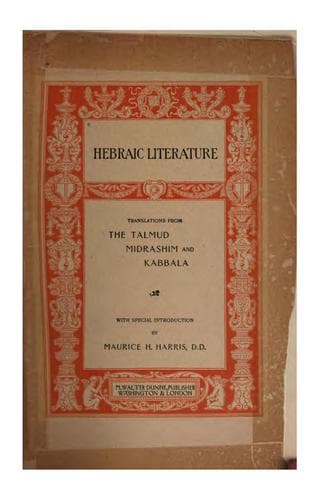
Hebraic Literature; Translations from the Talmud, Midrashim and Kabbala
Religion
Hebraic Literature; Translations from the Talmud, Midrashim and Kabbala
Hebrew literature -- Translations into English
9. God will not change or alter His law forever. He will never change
the law of Moses our Rabbi--peace be unto him! The law will suffer no
addition or diminution (but it will abide even), as the prophet Malachi
sealed it with the seal of the prophets in ending his words (Mal. iv.
4), "Remember ye the law of Moses My servant, which I commanded unto him
in Horeb for all Israel." Formerly the law was in a garment of light,
but in consequence of sin, the law became materialized in a garment of
skin, in the same proportion as man became materialized in a body of
flesh. In the future, after the redemption, however, the law will have
the garment of light restored, and the Messiah will preach the law in
terrible mysteries, such as no ear has ever heard, and it will appear to
us as a new law. But the law will not be altered, or made new, as the
nations of the world say. Jer. xxxi. 30-33.
10. He observeth and knoweth all our secrets, etc.
11. There are rewards and punishments in the future, etc.
12. He will send at the end of days our Messiah from the seed of David
to redeem His people Israel from among the nations, and restore to them
the kingdom.
13. There will be a revival of the dead, etc.
_Kitzur Sh'th_, fol. 7, col. 2.
Let a man believe that whatever occurs to him is from the Blessed One!
For instance, when a wicked man meets him and abuses him, and puts him
to shame, let him receive it with love, and say, "The Lord told him to
curse, and he is the messenger of God on account of my sin."
Ibid., fol. 8, col. 1.
In every deed or transaction a man performs by his own free will, be it
a matter of precept or of option, let the name of God be ready in his
mouth. If, for instance, he erects a building, or buys a vessel, or
makes a new garment, let him say with his mouth and utter with his lips,
"This thing I do, for (the honor of) the union of the Shechinah with the
Holy One--blessed be He!"
Ibid.
Bismillahi Arrahmani Arraheemi, "In the name of God, most
merciful and compassionate," is the motto of every work
undertaken by a Mohammedan.
A man should always desire that his neighbor may profit by him, and let
him not strive to profit by his neighbor. Let his words be pleasant with
the children of men if they shame him, and let him not shame them in
return. If they deceive him, let him not deceive them in return, and let
him take the yoke of the public upon his shoulders, and not impose it
heavily on them in return.
Ibid.
If--which God forbid!--thy neighbor has done thee an evil, pardon him at
once; for thou shouldst love him as thyself. If one hand is accidentally
hurt by the other, should the wounded hand revenge its injury on the
other? And, as urged before, thou shouldst rather say in thine heart,
"It is from the Lord that it came to thee; it came as a messenger from
the Holy One--blessed be He!--as a punishment for some sin."
_Kitzur Sh'lh_, fol. 9. col. 2.
Public-domain text, read in full here on John Shaqi.
Reviews
Reviews
No reviews yet
Be the first to share your thoughts on this work.
Elsewhere in the archive
Join the Discussion
Join the discussion
Sign in to leave a comment or review.
Sign InorCreate an account