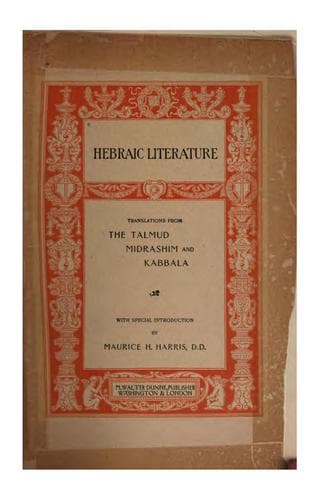
Hebraic Literature; Translations from the Talmud, Midrashim and Kabbala
Religion
Hebraic Literature; Translations from the Talmud, Midrashim and Kabbala
Hebrew literature -- Translations into English
A sage who was very sorrowful was once comforted thus: "If thy sorrow
relates to this world, may God decrease it; but if it relates to the
world to come, may God increase it and add sorrow to sorrow." (See 2
Cor. vii. 10.)
Ibid., fol. 10, col. 1.
A man should not wade through water or traverse any dangerous place in
company with an apostate, or even a wicked Jew, lest he be overtaken (in
the same ruin) with him. (Comp. Eph. v. 7, 8; Rev. xviii. 4.)
Ibid., fol. 10, col. 2.
The influence of the son is relatively greater and more blessed than
that of the father, for the merits of the father do not profit the son
except in matters relating to this world (as by bequeathing him worldly
inheritance); whereas the merits of the son do more than benefit the
father in this world; they benefit him also in the world to come (by
saying "Kadish"), which is enough to deliver his soul from purgatory.
Ibid., fol. 11, col. 2.
A common proverb says, "One father willingly maintains ten sons, but ten
sons are not willing to support one father."
Ibid., fol. 12, col. 2.
The proper use of money is that thou learn the art of dealing honestly,
so that thy No be no and thy Yes, yes; and as far as possible be
benevolent with the money. "And the liberal by liberal things shall
stand" (Isa. xxxii. 8).
Ibid.
The sage says, "The eye of a needle is not narrow enough for two
friends, but the world in not wide enough for two enemies."
Ibid., fol. 14, col. 1.
"Create in me a clean heart, O God, and renew a right spirit within me"
(Ps. li. 10). Know thou that the heart is the source of life, and is
placed in the centre of the body as the Holy of holies, as stated in the
Book Zohar, is the central part of the world. Therefore one must have
his heart cleansed from evil and all evil thoughts, otherwise he
introduces an idol into the innermost part of the Temple, which ought to
be a dwelling-place for the Shechinah. (See 1 Cor. iii, 16, 17, and vi.
19.)
_Kitzur Sh'lh_, fol. 14, col. 2.
He who gazes even on the little finger of a woman is as if he looked on
her to lust after her. He should not give ear to a woman's voice, for
the voice of a woman is lewdness. This sin is much discussed in the
Zohar; it causes the husband to come to poverty, and deprives him and
her sons of all respect.
Ibid., fol. 17, col. 1.
The sages of the Kabbalah were not singular in this view. The
Talmud Yerush, Callah, fol. 58, col. 3, says, "He that looks
upon a woman's heel is guilty of an act of lewdness."
Eating meat after cheese or cheese after meat is a very serious sin; and
it is stated in the Zohar, section Mishpatim, that upon him who is
without scruple in this regard, an evil spirit will rest for forty days,
his soul will be from the spirit which has no holiness.
Ibid., fol. 18, col. 2.
Public-domain text, read in full here on John Shaqi.
Reviews
Reviews
No reviews yet
Be the first to share your thoughts on this work.
Elsewhere in the archive
Join the Discussion
Join the discussion
Sign in to leave a comment or review.
Sign InorCreate an account