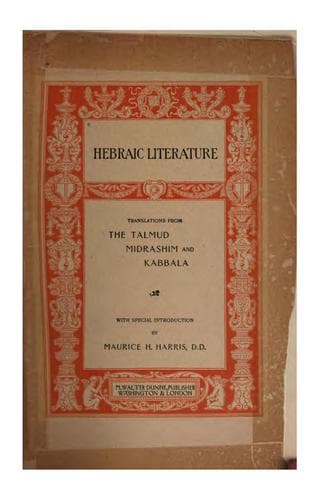
Hebraic Literature; Translations from the Talmud, Midrashim and Kabbala
Religion
Hebraic Literature; Translations from the Talmud, Midrashim and Kabbala
Hebrew literature -- Translations into English
Should he forget to fold his veil (Tallith), he is to shake it
thoroughly the next morning, in order to get rid of the evil spirits
that have harbored there during the night, and the reason is known to
the lords of the Kabbalah.
Ibid., fol. 71, col. 1.
It is customary then to repeat a number of hymns and songs and legends
wherein Elijah the Prophet is mentioned, because he it is that is to
come and bring the tidings of redemption, for it is thus stated in
Tosephta, that on the exit of the Sabbath Elijah of blessed memory sits
under the "Tree of Life" and records in writing the merits of those that
keep the Sabbath. Those that are particular repeat, and the very pious
write, "Elijah the Prophet, Elijah the Prophet, Elijah the Prophet," a
hundred and thirty times, for "Elijah the Prophet," by Gematria equals
120, to which add 10, the number of the letters, and the total is 130.
Ibid.
The word Elijah is written a hundred and thirty times in tabular form,
with the letters transposed. This can be understood better by forming a
Kabbalistic table of the same word in English.
Elijah Ehlija Ejahli Eijahl Elhija
Elahij Eljahi Elhaji Eljiah Ealijh
Eahlij Eajhli Eaijhl Ealhij Ehalij
Ehlaij Ehijla Ehjial Ehialj Ehjail
and so on.
The last day of the month is called, "The little Day of Atonement," and
it is fit and proper to do penance on that day. On the first day of the
month it is a pious act to prepare an extra dish for dinner in honor of
the day. God has given the first of the month (as a festival) more for
women than for men, because the three annual festivals are according to
the three patriarchs, Abraham, Isaac, and Jacob, and because the twelve
months are according to the twelve tribes; and as the tribes sinned in
the matter of the golden calf, and the women were unwilling to give up
their golden earrings for that idolatrous purpose, therefore they
deserved that God should give them as their reward the first days of the
twelve months, according to the number of the tribes.
_Kitzur Sh'lh_, fol. 72, col. 1.
It is a very pious act to bless the moon at the close of the Sabbath,
when one is dressed in his best attire and perfumed. If the blessing is
to be performed on the evening of an ordinary week-day the best dress is
to be worn. According to the Kabbalists the blessings upon the moon are
not to be said till seven full days after her birth, but, according to
later authorities, this may be done after three days. The reason for not
performing this monthly service under a roof, but in the open air, is
because it is considered as a reception of the presence of the
Shechinah, and it would not be respectful so to do anywhere but in the
open air. It depends very much upon circumstances when and where the new
moon is to be consecrated, and also upon one's own predisposition, for
authorities differ. We will close these remarks with the conclusion of
the Kitzur Sh'lu on the subject, which, at p. 72, col. 2, runs thus:--
Public-domain text, read in full here on John Shaqi.
Reviews
Reviews
No reviews yet
Be the first to share your thoughts on this work.
Elsewhere in the archive
Join the Discussion
Join the discussion
Sign in to leave a comment or review.
Sign InorCreate an account