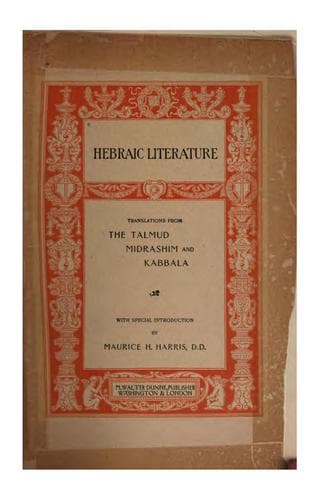
Hebraic Literature; Translations from the Talmud, Midrashim and Kabbala
Religion
Hebraic Literature; Translations from the Talmud, Midrashim and Kabbala
Hebrew literature -- Translations into English
"When about to sanctify the new moon, one should straighten his feet (as
at the Shemonah-esreh) and give one glance at the moon before he begins
to repeat the ritual blessing, and having commenced it he should not
look at her at all. Thus should he begin--'In the united name of the
Holy and Blessed One and His Shechinah, through that Hidden and
Concealed One! and in the name of all Israel!' Then he is to proceed
with the 'Form of Prayer for the New Moon;' word for word, without
haste, but with solemn deliberation, and when he repeats--
"'Blessed is thy Former, blessed is thy Maker, blessed is thy
Possessor, blessed is thy Creator.'
"He is to meditate on the initials of the four divine epithets which
form 'Jacob,' for the moon, which is called 'the lesser light,' is his
emblem or symbol, and he is also called 'little' (see Amos vii. 2). This
he is to repeat three times. He is to skip three times while repeating
thrice the following sentence, and after repeating three times forward
and backward: thus (forward)--'Fear and dread shall fall upon them by
the greatness of Thine arm; they shall be as still as a stone;' thus
(backward)--'Still as a stone may they be; by the greatness of Thine arm
may fear and dread fall on them;' he then is to say to his neighbor
three times, 'Peace be unto you,' and the neighbor is to respond three
times, 'Unto you be peace.' Then he is to say three times (very loudly),
'David, the king of Israel, liveth and existeth!' and finally, he is to
say three times--
"'May a good omen and good luck be upon us and upon all Israel!
Amen.'"
RABBINICAL ANA
It was said of Rabbi Tarphon, that though a very wealthy man, he was not
charitable according to his means. One time Rabbi Akiba said to him.
"Shall I invest some money for thee in real estate, in a manner which
will be very profitable?" Rabbi Tarphon answered in the affirmative, and
brought to Rabbi Akiba four thousand denars in gold, to be so applied.
Rabbi Akiba immediately distributed the same among the poor. Some time
after this Rabbi Tarphon met Rabbi Akiba, and asked him where the real
estate which he had bought for him was situated. Akiba led his friend to
the college, and showed him a little boy, who recited for them the 112th
psalm. When he reached the ninth verse, "He distributeth, he giveth to
the needy, his righteousness endureth forever."
"There," said Akiba, "thy property is with David, the king of Israel,
who said, 'he distributeth, he giveth to the needy.'"
"And wherefore hast thou done this?" asked Tarphon.
"Knowest thou not," answered Rabbi Akiba, "how Nakdimon, the son of
Guryon, was punished because he gave not according to his means?"
"Well," returned the other, "why didst thou not tell me this; could I
not have distributed my means without thy aid?"
"Nay," said Akiba, "it is a greater virtue to cause another to give than
to give one's self."
Public-domain text, read in full here on John Shaqi.
Reviews
Reviews
No reviews yet
Be the first to share your thoughts on this work.
Elsewhere in the archive
Join the Discussion
Join the discussion
Sign in to leave a comment or review.
Sign InorCreate an account