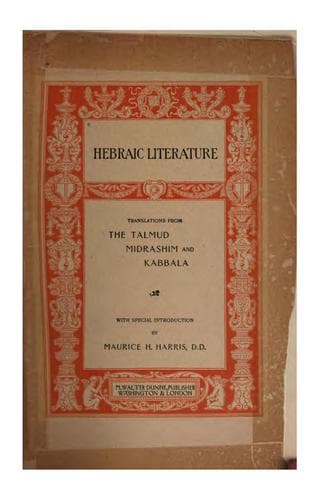
Hebraic Literature; Translations from the Talmud, Midrashim and Kabbala
Religion
Hebraic Literature; Translations from the Talmud, Midrashim and Kabbala
Hebrew literature -- Translations into English
Rabbi Jochanan, the son of Lakkai, was once riding outside of Jerusalem,
and his pupils had followed him. They saw a poor woman collecting the
grain which dropped from the mouths and troughs of some feeding cattle,
belonging to Arabs. When she saw the Rabbi, she addressed him in these
brief words, "O Rabbi, assist me." He replied, "My daughter, whose
daughter art thou?" "I am the daughter of Nakdimon, the son of Guryon,"
she answered.
"Why, what has become of thy father's money?" asked the Rabbi; "the
amount which thou didst receive as a dowry on thy wedding day?"
"Ah," she replied, "is there not a saying in Jerusalem, 'The salt was
wanting to the money?'"
"And thy husband's money," continued the Rabbi; "what of that?"
"That followed the other," she answered; "I have lost them both."
The Rabbi turned to his scholars and said:--
"I remember, when I signed her marriage contract, her father gave her as
a dowry one million golden denars, and her husband was wealthy in
addition thereto."
The Rabbi sympathized with the woman, helped her, and wept for her.
"Happy are ye, oh sons of Israel," he said; "as long as ye perform the
will of God naught can conquer ye; but if ye fail to fulfill His wishes,
even the cattle are superior to ye."
Nachum, whatever occurred to him, was in the habit of saying, "This too
is for the best." In his old age he became blind; both of his hands and
both of his legs were amputated, and the trunk of his body was covered
with a sore inflammation. His scholars said to him, "If thou art a
righteous man, why art thou so sorely afflicted?"
"All this," he answered, "I brought upon myself. Once I was traveling to
the house of my father-in-law, and I had with me thirty asses laden with
provisions and all manner of precious articles. A man by the wayside
called to me, 'O Rabbi, assist me.' I told him to wait until I unloaded
my asses. When that time arrived and I had removed their burdens from my
beasts, I found to my sorrow that the poor man had fallen and expired. I
threw myself upon his body and wept bitterly. 'Let these eyes, which had
no pity on thee, be blind,' I said; 'these hands that delayed to assist
thee, let them be cut off, and also these feet, which did not run to aid
thee,' And yet I was not satisfied until I prayed that my whole body
might be stricken with a sore inflammation. Rabbi Akiba said to me, 'Woe
to me that I find thee in this state! But I replied, 'Happy to thee that
thou meetest me in this state, for through this I hope that my iniquity
may be forgiven, and all my righteous deeds still remain recorded to
gain me a reward of life eternal in the future world.'"
* * * * *
Rabbi Janay upon seeing a man bestowing alms in a public place, said,
"Thou hadst better not have given at all, than to have bestowed alms so
openly and put the poor man to shame."
"One should rather be thrown into a fiery furnace than be the means of
bringing another to public shame."
Public-domain text, read in full here on John Shaqi.
Reviews
Reviews
No reviews yet
Be the first to share your thoughts on this work.
Elsewhere in the archive
Join the Discussion
Join the discussion
Sign in to leave a comment or review.
Sign InorCreate an account