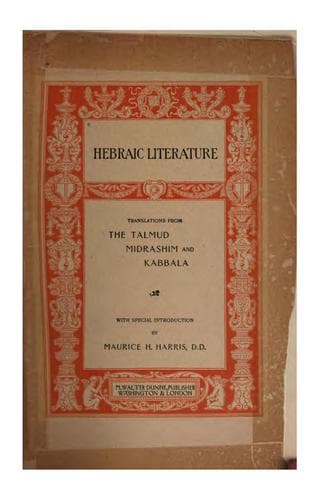
Hebraic Literature; Translations from the Talmud, Midrashim and Kabbala
Religion
Hebraic Literature; Translations from the Talmud, Midrashim and Kabbala
Hebrew literature -- Translations into English
Rabbi Chonan, of Zepora said, "The study of the law may be compared to a
huge heap of dust that is to be cleared away. The foolish man says, 'It
is impossible that I should be able to remove this immense heap, I will
not attempt it;' but the wise man says, 'I will remove a little to-day,
some more to-morrow, and more the day after, and thus in time I shall
have removed it all.'
"It is the same with studying the law. The indolent pupil says, 'It is
impossible for me to study the Bible. Just think of it, fifty chapters
in Genesis; sixty-six in Isaiah, one hundred and fifty Psalms, etc. I
cannot do it;' but the industrious student says, 'I will study six
chapters every day, and so in time I shall acquire the whole.'"
In Proverbs 24:7, we find this sentence: "Wisdom is too high for a
fool."
"Rabbi Jochanan illustrates this verse with an apple depending from the
ceiling. The foolish man says, 'I cannot reach the fruit, it is too
high;' but the wise man says, 'It may be readily obtained by placing one
step upon another until thy arm is brought within reach of it.' The
foolish man says, 'Only a wise man can study the entire law,' but the
wise man replies, 'It is not incumbent upon thee to acquire the whole.'"
Rabbi Levi illustrates this by a parable.
A man once hired two servants to fill a basket with water. One of them
said, "Why should I continue this useless labor? I put the water in one
side and it immediately leaks out of the other; what profit is it?"
The other workman, who was wise, replied, "We have the profit of the
reward which we receive for our labor."
It is the same in studying the law. One man says, "What does it profit
me to study the law when I must ever continue it or else forget what I
have learned." But the other man replies, "God will reward us for the
will which we display even though we do forget."
Rabbi Ze-irah has said that even a single letter in the law which we
might deem of no importance, if wanting, would neutralize the whole law.
In Deuteronomy 22:17, we read, "Neither shall he take to himself many
wives, that his heart may turn away." Solomon transgressed this precept,
and it is said by Rabbi Simon that the angels took note of his ill-doing
and addressed the Deity: "Sovereign of the world, Solomon has made Thy
law even as a law liable to change and diminution. Three precepts he has
disregarded, namely, 'He shall not acquire for himself many horses';
'neither shall he take to himself many wives'; 'nor shall he acquire to
himself too much silver and gold.'" Then the Lord replied, "Solomon will
perish from the earth; aye, and a hundred Solomons after him, and yet
the smallest letter of the law shall not be dispensed with."
* * * * *
Public-domain text, read in full here on John Shaqi.
Reviews
Reviews
No reviews yet
Be the first to share your thoughts on this work.
Elsewhere in the archive
Join the Discussion
Join the discussion
Sign in to leave a comment or review.
Sign InorCreate an account