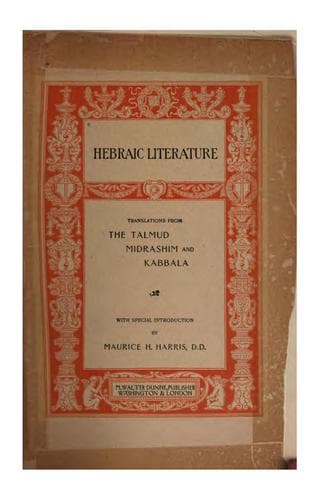
Hebraic Literature; Translations from the Talmud, Midrashim and Kabbala
Religion
Hebraic Literature; Translations from the Talmud, Midrashim and Kabbala
Hebrew literature -- Translations into English
The Rabbis have often applied in a figurative sense, various passages of
Holy Writ, among others the opening verse of the 55th chapter of Isaiah.
"Ho, every one of ye that thirsteth, come ye to the water, and he, too,
that hath no money; come ye, buy and eat; yea, come, buy without money
and without price, wine and milk."
The three liquids which men are thus urged to procure are considered by
the sages of Israel as typical of the law.
One Rabbi asked, "Why is the word of God compared to water?"
To this question the following answer was returned: "As water runs down
from an eminence (the mountains), and rests in a low place (the sea), so
the law, emanating from Heaven, can remain in the possession of those
only who are humble in spirit."
Another Rabbi inquired, "Wherefore has the Word of God been likened to
wine and milk?" The reply made was, "As these fluids cannot be preserved
in golden vessels, but only in those of earthenware, so those minds will
be the best receptacles of learning which are found in homely bodies."
Rabbi Joshua ben Chaninah, who was very homely in appearance, possessed
great wisdom and erudition; and one of his favorite sayings was, that
"though many have exhibited a vast amount of knowledge, notwithstanding
their personal attractions, yet had they been less handsome, their
acquirements might have been more extensive."
The precepts are compared to a lamp; the law of God to a light. The lamp
gives light only so long as it contains oil. So he who observes the
precepts receives his reward while performing them. The law, however, is
a light perpetual; it is a protection forever to the one who studies it,
as it is written:--
"When thou walkest, it (the law) will guide thee; when thou liest down,
it will watch over thee; and when thou awakest, it will converse with
thee."
When thou walkest it will guide thee--in this world; when thou liest
down, it will watch over thee--in the grave; when thou awakest, it
will converse with thee--in the life to come.
A traveler upon his journey passed through the forest upon a dark and
gloomy night. He journeyed in dread; he feared the robbers who infested
the route he was traversing; he feared that he might slip and fall into
some unseen ditch or pitfall on the way, and he feared, too, the wild
beasts, which he knew were about him. By chance he discovered a pine
torch, and lighted it, and its gleams afforded him great relief. He no
longer feared brambles or pitfalls, for he could see his way before him.
But the dread of robbers and wild beasts was still upon him, nor left
him till the morning's dawn, the coming of the sun. Still he was
uncertain of his way, until he emerged from the forest, and reached the
cross-roads, when peace returned unto his heart.
Public-domain text, read in full here on John Shaqi.
Reviews
Reviews
No reviews yet
Be the first to share your thoughts on this work.
Elsewhere in the archive
Join the Discussion
Join the discussion
Sign in to leave a comment or review.
Sign InorCreate an account