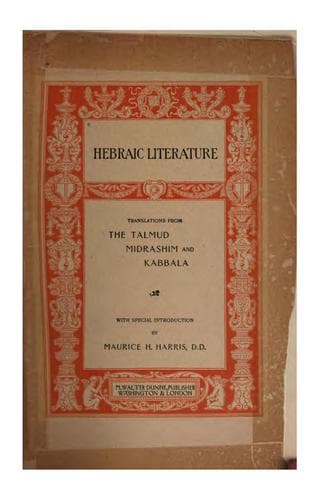
Hebraic Literature; Translations from the Talmud, Midrashim and Kabbala
Religion
Hebraic Literature; Translations from the Talmud, Midrashim and Kabbala
Hebrew literature -- Translations into English
When souls stand at the judgment-seat of God, the poor, the rich, and
the wicked each are severally asked what excuse they can offer for not
having studied the law. If the poor man pleads his poverty he is
reminded of Hillel. Though Hillel's earnings were small he gave half
each day to gain admittance to the college.
When the rich man is questioned, and answers that the care of his
fortune occupied his time, he is told that Rabbi Eleazer possessed a
thousand forests and a thousand ships, and yet abandoned all the
luxuries of wealth and journeyed from town to town searching and
expounding the law.
When the wicked man pleads temptation as an excuse for his evil course,
he is asked if he has been more tempted than Joseph, more cruelly tried
than he was, with good or evil fortune.
Yet though we are commanded to study God's law, we are not to make of it
a burden; neither are we to neglect for the sake of study any other duty
or reasonable recreation. "Why," once asked a pupil, "is 'thou shalt
gather in thy corn in its season' a Scriptural command? Would not the
people gather their corn when ripe as a matter of course? The command is
superfluous."
"Not so," replied the Rabbis; "the corn might belong to a man who for
the sake of study would neglect work. Work is holy and honorable in
God's sight, and He would not have men fail to perform their daily
duties even for the study of His law."
* * * * *
Bless God for the good as well as for the evil. When you hear of a death
say, "Blessed is the righteous Judge."
Prayer is Israel's only weapon, a weapon inherited from its fathers, a
weapon proved in a thousand battles. Even when the gates of prayer are
shut in heaven, those of tears are open.
We read that in the contest with Amalek, when Moses lifted up his arms
Israel prevailed. Did Moses's hands affect the war, to make it or to
break it? No; but while the ones of Israel look upward with humble heart
to the Great Father in Heaven, no evil can prevail against them.
"And Moses made a serpent of brass and put it upon a pole; and it came
to pass that if a serpent had bitten any man, when he beheld the serpent
of brass he lived."
Had the brazen serpent the power of killing or of giving life? No; but
while Israel looks upward to the Great Father in Heaven, He will grant
life.
"Has God pleasure in the meat and blood of sacrifices?" ask the
prophets.
No. He has not so much ordained as permitted them. "It is for
yourselves," He says; "not for me, that ye offer."
A king had a son whom he daily discovered carousing with dissolute
companions, eating and drinking. "Eat at my table," said the king; "eat
and drink, my son, even as pleaseth thee; but let it be at my table, and
not with dissolute companions."
The people loved sacrificing, and they made offerings to strange gods;
therefore, God said to them: "If ye will sacrifice, bring your offerings
at least to me."
Public-domain text, read in full here on John Shaqi.
Reviews
Reviews
No reviews yet
Be the first to share your thoughts on this work.
Elsewhere in the archive
Join the Discussion
Join the discussion
Sign in to leave a comment or review.
Sign InorCreate an account