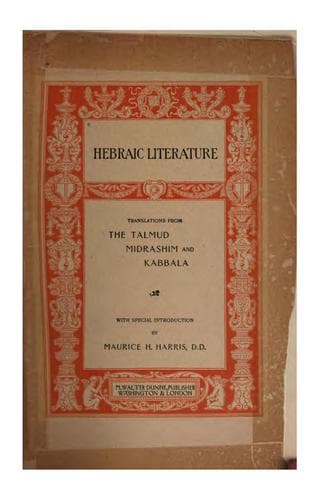
Hebraic Literature; Translations from the Talmud, Midrashim and Kabbala
Religion
Hebraic Literature; Translations from the Talmud, Midrashim and Kabbala
Hebrew literature -- Translations into English
Scripture ordains that the Hebrew slave who loves his bondage shall have
his ears pierced against the doorpost. Why?
Because that ear heard from Sinai's heights these words: "They are my
servants; they shall not be sold as bondsmen." My servants, and not lay
servant's servants; therefore, pierce the ear of the one who loves his
bondage and rejects the freedom offered him.
He who sacrifices a whole offering shall be rewarded for a whole
offering; he who offers a burnt-offering shall have the reward of a
burnt-offering; but he who offers humility to God and man shall receive
as great a reward as though he had offered all the sacrifices in the
world.
* * * * *
The God of Abraham will help the one who appoints a certain place to
pray to the Lord.
Rabbi Henah said, "When such a man dies they will say of him, 'A pious
man, a meek man, hath died; he followed the example of our father
Abraham.'"
How do we know that Abraham appointed a certain place to pray?
"Abraham rose early in the morning and went to the place where he stood
before the Lord."
Rabbi Chelboh said, "We should not hurry when we leave a place of
worship."
"This," said Abayyeh, "is in reference to leaving a place of worship;
but we should certainly hasten on our way thither, as it is written,
'Let us know and hasten to serve the Lord.'"
Rabbi Zabid said, "When I used to see the Rabbis hurrying to a lecture
in their desire to obtain good seats, I thought to myself, 'they are
violating the Sabbath.' When, however, I heard Rabbi Tarphon say, 'One
should always hasten to perform a commandment even on the Sabbath,' as
it is written, 'They shall follow after the Lord when He roareth like a
lion,' I hurried also, in order to be early in attendance."
That place wherein we can best pray to God is His house; as it is
written:--
"To listen to the praises and prayers which Thy servant prays before
Thee." Alluding to the service in the house of God.
Said Rabin, the son of Ada, "Whence do we derive the tradition, that
when ten men are praying in the house of God the Divine Presence rests
among them?
"It is written, 'God stands in the assembly of the mighty.' That an
assembly or congregation consists of not less than ten, we learn from
God's words to Moses in regard to the spies who were sent out to view
the land of Canaan. 'How long,' said he, 'shall indulgence be given to
this evil congregation?' Now the spies numbered twelve men; but Joshua
and Caleb being true and faithful, there remained but ten to form the
'evil congregation.'"
"Whence do we derive the tradition that when even one studies the law,
the Divine Presence rests with him?"
"It is written, 'In every place where I shall permit my name to be
mentioned, I will come unto thee and I will bless thee.'"
* * * * *
Public-domain text, read in full here on John Shaqi.
Reviews
Reviews
No reviews yet
Be the first to share your thoughts on this work.
Elsewhere in the archive
Join the Discussion
Join the discussion
Sign in to leave a comment or review.
Sign InorCreate an account