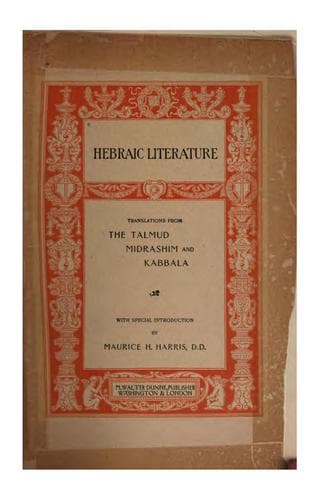
Hebraic Literature; Translations from the Talmud, Midrashim and Kabbala
Religion
Hebraic Literature; Translations from the Talmud, Midrashim and Kabbala
Hebrew literature -- Translations into English
Miriam waited for Moses one hour (when he was in the box of bulrushes).
Therefore the Israelites waited for Miriam seven days, when she became
leprous. "And the people did not set forward until Miriam was brought in
again."
Joseph buried his father. "And Joseph went up to bury his father." There
was none greater among the children of Israel than Joseph. Moses
excelled him afterward, however; therefore we find, "And Moses took the
bones of Joseph with him." But the world has seen none greater than
Moses, therefore 'tis written, "And He (God) buried him in the valley."
* * * * *
When trouble and sorrow become the portion of Israel, and the
fainthearted separate from their people, two angels lay their hands upon
the head of him who withdraws, saying, "This one shall not see the
comfort of the congregation."
When trouble comes to the congregation it is not right for a man to say,
"I will go home; I will eat and drink; and things shall be peaceful to
me;" 'tis of such a one that the holy book speaks, saying, "And behold
there is gladness and joy; slaying of oxen, and killing of sheep; eating
of flesh, and drinking of wine. 'Let us eat and drink, for to-morrow we
must die.' And it was revealed in my ears by the Lord of Hosts; surely
the iniquity shall not be forgiven ye until ye die."
Our teacher, Moses, always bore his share in the troubles of the
congregation, as it is written, "They took a stone and put it under
him." Could they not have given him a chair or a cushion? But then he
said, "Since the Israelites are in trouble (during the war with Amalek)
lo, I will bear my part with them, for he who bears his portion of the
burden will live to enjoy the hour of consolation. Woe to the one who
thinks, 'Ah, well, I will neglect my duty; who can know whether I bear
my part or not;' even the stones of his house, aye, the limbs of the
trees, shall testify against him, as it is written, 'For the stones will
cry from the wall, and the limbs of the trees will testify.'"
* * * * *
Rabbi Meir said, "When a man teaches his son a trade, he should pray to
the Possessor of the world, the Dispenser of wealth and poverty; for in
every trade and pursuit of life both the rich and the poor are to be
found. It is folly for one to say, 'This is a bad trade, it will not
afford me a living;' because he will find many well to do in the same
occupation. Neither should a successful man boast and say, 'This is a
great trade, a glorious art, it has made me wealthy;' because many
working in the same line as himself have found but poverty. Let all
remember that everything is through the infinite mercy and wisdom of
God."
Public-domain text, read in full here on John Shaqi.
Reviews
Reviews
No reviews yet
Be the first to share your thoughts on this work.
Elsewhere in the archive
Join the Discussion
Join the discussion
Sign in to leave a comment or review.
Sign InorCreate an account