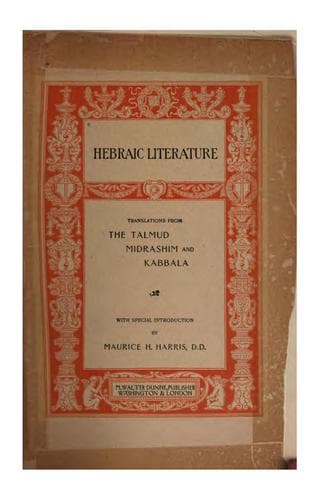
Hebraic Literature; Translations from the Talmud, Midrashim and Kabbala
Religion
Hebraic Literature; Translations from the Talmud, Midrashim and Kabbala
Hebrew literature -- Translations into English
Rabbi Simon, the son of Eleazer, said, "Hast thou ever noted the fowls
of the air and beasts of the field how easily their maintenance is
provided for them; and yet they were only created to serve me. Now
should not I find a livelihood with even less trouble, for I was made to
serve my fellow-creatures? But, alas! I sinned against my Creator,
therefore am I punished with poverty and obliged to labor."
Rabbi Judah said, "Most mule-drivers are cruel. They beat their poor
beasts unmercifully. Most camel-drivers are upright. They travel through
deserts and dangerous places, and have time for meditation and thoughts
of God. The majority of seamen are religious. Their daily peril makes
them so. The best doctors are deserving of punishment. In the pursuit of
knowledge they experiment on their patients, and often with fatal
results. The best of butchers deserve to be rated with the Amalekites,
they are accustomed to blood and cruelty; as it is written of the
Amalekites, 'How he met thee by the way and smote the hindmost of thee,
and that were feeble behind thee, when thou wast faint and weary.'"
* * * * *
Man is born with his hands clenched; he dies with his hands wide open.
Entering life he desires to grasp everything; leaving the world, all
that he possessed has slipped away.
Even as a fox is man; as a fox which seeing a fine vineyard lusted after
its grapes. But the palings were placed at narrow distances, and the fox
was too bulky to creep between them. For three days he fasted, and when
he had grown thin he entered into the vineyard. He feasted upon the
grapes, forgetful of the morrow, of all things but his enjoyment; and
lo, he had again grown stout and was unable to leave the scene of his
feast. So for three days more he fasted, and when he had again grown
thin, he passed through the palings and stood outside the vineyard,
meagre as when he entered.
So with man; poor and naked he enters the world, poor and naked does he
leave.
Alexander wandered to the gates of Paradise and knocked for entrance.
"Who knocks?" demanded the guardian angel.
"Alexander."
"Who is Alexander?"
"Alexander--the Alexander--Alexander the Great--the conqueror of the
world."
"We know him not," replied the angel; "this is the Lord's gate, only the
righteous enter here."
Alexander begged for something to prove that he had reached the gates of
Paradise, and a small piece of a skull was given to him. He showed it to
his wise men, who placed it in one scale of a balance, Alexander poured
gold and silver into the other scale, but the small bone weighed
heavier; he poured in more, adding his crown jewels, his diadem; but
still the bone outweighed them all. Then one of the wise men, taking a
grain of dust from the ground placed that upon the bone, and lo, the
scale flew up.
The bone was that which surrounds the eye of man; the eye of man which
naught can satisfy save the dust which covers it in the grave.
Public-domain text, read in full here on John Shaqi.
Reviews
Reviews
No reviews yet
Be the first to share your thoughts on this work.
Elsewhere in the archive
Join the Discussion
Join the discussion
Sign in to leave a comment or review.
Sign InorCreate an account