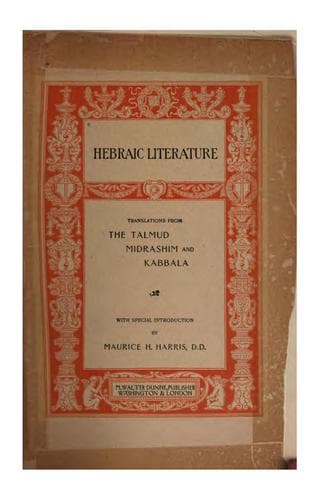
Hebraic Literature; Translations from the Talmud, Midrashim and Kabbala
Religion
Hebraic Literature; Translations from the Talmud, Midrashim and Kabbala
Hebrew literature -- Translations into English
"'O Eternal! God of Abraham, Isaac, and Jacob, and their descendants,
the heavens and the earth are the works of Thy hand. Thou didst give to
the sea a shore, controlling with a word the power of the mighty deep.
Thou art merciful as Thou art great, and Thou hast promised to accept
the repentance of those who return to Thee with upright hearts. As
numerous are my sins as the sands which cover the seashore. I have done
evil before Thee, committing abominations in Thy presence and acting
wickedly. Bound with fetters I come before Thee, and on my knees I
entreat Thee, in the name of Thy great attributes of mercy, to
compassionate my suffering and my distress. Pardon me, O Lord, forgive
me. Do not utterly destroy me because of my transgressions. Let not my
punishment eternally continue. Though I am unworthy of Thy goodness, O
Lord, yet save me in Thy mercy. Henceforth will I praise Thy name all
the days of my life, for all Thy creatures delight in praising Thee, and
unto Thee is the greatness and the goodness forever and ever, Selah!'"
"God heard this prayer, even as it is written, 'And He permitted Himself
to be entreated by him, and brought him back to Jerusalem unto his
kingdom.'"
"From which we may learn," continued Akiba, "that affliction is an
atonement for sin."
* * * * *
Said Rabbi Eleazer, the great, "It is commanded 'thou shalt love the
Lord thy God with all thy soul and with all that is loved by thee.'
"Does not 'with all thy soul' include 'with all that is loved by thee?'
"Some people love themselves more than they love their money; to them
'tis said, 'with all thy soul;' while for those who love their money
more than themselves the commandment reads, 'with all that is loved by
thee.'"
But Rabbi Akiba always expounded the words, "with all thy soul," to mean
"even though thy life be demanded of thee."
When the decree was issued forbidding the Israelites to study the law,
what did Rabbi Akiba?
He installed many congregations secretly, and in secret lectured before
them.
Then Papus, the son of Juda said to him:--
"Art not afraid, Akiba? Thy doings may be discovered, and thou wilt be
punished for disobeying the decree."
"Listen, and I will relate to thee a parable," answered Akiba. "A fox,
walking by the river side, noticed the fishes therein swimming and
swimming to and fro, never ceasing; so he said to them, 'Why are ye
hurrying, what do ye fear?'
"'The nets of the angler,' they replied.
"'Come, then,' said the fox, 'and live with me on dry land.'
"But the fishes laughed.
"'And art thou called the wisest of the beasts?' they exclaimed; 'verily
thou art the most foolish. If we are in danger even in our element, how
much greater would be our risk in leaving it.'
"It is the same with us. We are told of the law that it is 'our life and
the prolongation of our days.' This is it when things are peaceful with
us; how much greater is our need of it then in times like these?"
Public-domain text, read in full here on John Shaqi.
Reviews
Reviews
No reviews yet
Be the first to share your thoughts on this work.
Elsewhere in the archive
Join the Discussion
Join the discussion
Sign in to leave a comment or review.
Sign InorCreate an account