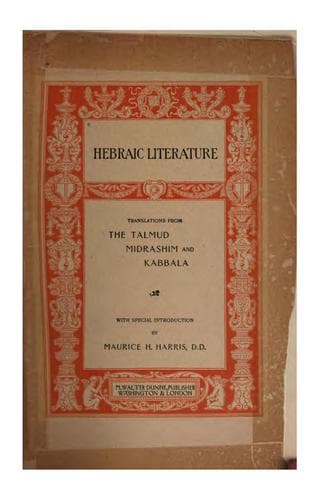
Hebraic Literature; Translations from the Talmud, Midrashim and Kabbala
Religion
Hebraic Literature; Translations from the Talmud, Midrashim and Kabbala
Hebrew literature -- Translations into English
It is said that it was but shortly after this when Rabbi Akiba was
imprisoned for teaching the law, and in the prison in which he was
incarcerated he found Papus, who had been condemned for some other
offense.
Rabbi Akiba said to him:--
"Papus, what brought thee here?"
And Papus replied:--
"Joy, joy, to thee, that thou art imprisoned for studying God's law; but
woe, woe is mine that I am here through vanity."
When Rabbi Akiba was led forth to execution, it was just at the time of
the morning service.
"'Hear, O Israel! the Lord our God, the Lord is one,'" he exclaimed in a
loud and firm voice.
The torturers tore his flesh with pointed cards, yet still he repeated,
"The Lord is one."
"Always did I say," he continued, "that 'with all thy soul,' meant even
though life should be demanded of thee, and I wondered whether I should
ever be able to so observe it. Now see, to-day, I do so; 'the Lord is
one.'"
With these word he died.
* * * * *
Elishah ben Abuyah, a most learned man, became in after-life an
apostate. Rabbi Meir had been one of his pupils, and he never failed in
the great love which he bore for his teacher.
It happened upon one occasion when Rabbi Meir was lecturing in the
college, that some students entered and said to him:--
"Thy teacher, Elishah, is riding by on horseback on this holy Sabbath
day."
Rabbi Meir left the college, and overtaking Elishah walked along by his
horse's side.
The latter saluted him, and asked:--
"What passage of Scripture hast thou been expounding?"
"From the book of Job," replied Rabbi Meir. "'The Lord blessed the
latter days of Job more than the beginning.'"
"And how didst thou explain the verse?" said Elishah.
"That the Lord increased his wealth twofold."
"But thy teacher, Akiba, said not so," returned Elishah. "He said that
the Lord blessed the latter days of Job with twofold of penitence and
good deeds."
"How," inquired Rabbi Meir, "wouldst thou explain the verse, 'Better is
the end of a thing than the beginning thereof.' If a man buys
merchandise in his youth and meets with losses, is it likely that he
will recover his substance in old age? Or, if a person studies God's law
in his youth and forgets it, is it probable that it will return to his
memory in his latter days?"
"Thy teacher, Akiba, said not so," replied Elishah; "he explained the
verse, 'Better is the end of a thing when the beginning was good.' My
own life proves the soundness of this explanation. On the day when I was
admitted into the covenant of Abraham, my father made a great feast.
Some of his visitors sang, some of them danced, but the Rabbis conversed
upon God's wisdom and His laws. This latter pleased my father, Abuyah,
and he said, 'When my son grows up ye shall teach him and he shall
become like ye; he did not cause me to study for God's sake but only to
make his name famous through me. Therefore, in my latter days have I
become wicked and an apostate; and now, return home.'"
Public-domain text, read in full here on John Shaqi.
Reviews
Reviews
No reviews yet
Be the first to share your thoughts on this work.
Elsewhere in the archive
Join the Discussion
Join the discussion
Sign in to leave a comment or review.
Sign InorCreate an account