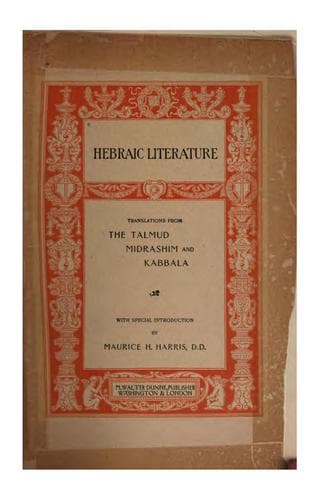
Hebraic Literature; Translations from the Talmud, Midrashim and Kabbala
Religion
Hebraic Literature; Translations from the Talmud, Midrashim and Kabbala
Hebrew literature -- Translations into English
The Rabbi's daughter said, "Let me answer this aspersion. Last night
robbers broke into my room, and stole therefrom a silver vessel: but
they left a golden one in its stead."
The emperor replied, "I wish that such thieves would come every night."
Thus was it with Adam; God took a rib from him, but placed a woman
instead of it.
Rabbi Joshua, of Saknin, said in the name of Rabbi Levi, "The Lord
considered from what part of the man he should form woman; not from the
head, lest she should be proud; not from the eyes, lest she should wish
to see everything; not from the mouth, lest she might be talkative; nor
from the ear, lest she should wish to hear everything; nor from the
heart, lest she should be jealous; nor from the hand, lest she should
wish to find out everything; nor from the feet in order that she might
not be a wanderer; only from the most hidden place, that is covered even
when a man is naked--namely, the rib."
The scholars of Rabbi Simon ben Jochai once asked him:--
"Why did not the Lord give to Israel enough manna to suffice them for a
year, at one time, instead of meting it out daily?"
The Rabbi replied:--
"I will answer ye with a parable. There was once a king who had a son to
whom he gave a certain yearly allowance, paying the entire sum for his
year's support on one appointed day. It soon happened that this day on
which the allowance was due, was the only day in the year when the
father saw his son. So the king changed his plan, and gave his son each
day his maintenance for that day only, and then the son visited his
father with the return of each day's sun.
"So was it with Israel; each father of a family, dependent upon the
manna provided each day by God's bounty, for his support and the support
of his family, naturally had his mind devoted to the Great Giver and
Sustainer of life."
When Rabbi Eleazer was sick his scholars visited him, and said, "Rabbi,
teach us the way of life, that we may inherit eternity."
The Rabbi answered, "Give honor to your comrades. Know to whom you pray.
Restrain your children from frivolous conversation, and place them among
the learned men, in order that they may acquire wisdom. So may you merit
life in the future world."
When Rabbi Jochanan was sick his scholars also called upon him. When he
beheld them he burst into tears.
"Rabbi!" they exclaimed, "Light of Israel! The chief pillar! Why weep?"
Public-domain text, read in full here on John Shaqi.
Reviews
Reviews
No reviews yet
Be the first to share your thoughts on this work.
Elsewhere in the archive
Join the Discussion
Join the discussion
Sign in to leave a comment or review.
Sign InorCreate an account