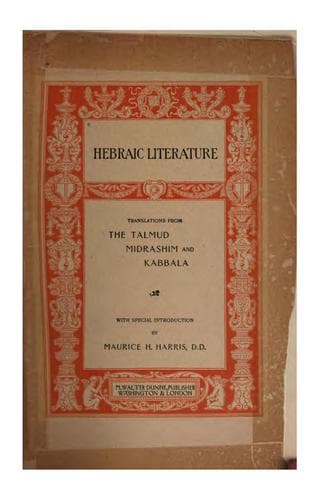
Hebraic Literature; Translations from the Talmud, Midrashim and Kabbala
Religion
Hebraic Literature; Translations from the Talmud, Midrashim and Kabbala
Hebrew literature -- Translations into English
The Rabbi answered, "Were I to be brought before a king of flesh and
blood, who is here to-day and to-morrow in the grave; who may be angry
with me, but not forever; who may imprison me, but not forever; who may
kill me, but only for this world; whom I may sometimes bribe; even then
I would fear. But now, I am to appear before the King of kings, the Most
Holy One, blessed be He, who lives through all eternity. If He is wroth,
it is forever. If He imprisons me, it is forever; if He slays me, it is
for the future world; and I can bribe Him neither with words nor money.
Not only this, two paths are before me, one leading to punishment, the
other to reward, and I know not which one I must travel. Should I not
weep?"
The scholars of Rabbi Johanan, the son of Zakai, asked of their teacher
this question:--
"Wherefore is it, that according to the law, the punishment of a
highwayman is not as severe as the punishment of a sneak thief?
According to the Mosaic law, if a man steals an ox or a sheep, and kills
it or sells it, he is required to restore five oxen for the one ox, and
four sheep for the one sheep; but for the highwayman we find, 'When he
hath sinned and is conscious of his guilt, he shall restore that he hath
taken violently away; he shall restore it and its principal, and the
fifth part thereof he shall add thereto.' Therefore, he who commits a
highway robbery pays as punishment one-fifth of the same, while a sneak
thief is obliged to return five oxen for one ox, and four sheep for one
sheep. Wherefore is this?"
"Because," replied the teacher, "the highway robber treats the servant
as the master. He takes away violently in the presence of the servant,
the despoiled man, and the master--God. But the sneak thief imagines
that God's eye is not upon him. He acts secretly, thinking, as the
Psalmist says, 'The Lord doth not see, neither will the God of Jacob
regard it.' Listen to a parable. Two men made a feast. One invited all
the inhabitants of the city, and omitted inviting the king. The other
invited neither the king nor his subjects. Which one deserves
condemnation? Certainly the one who invited the subjects and not the
king. The people of the earth are God's subjects. The sneak thief fears
their eyes, yet he does not honor the eye of the king, the eye of God,
which watches all his actions."
Rabbi Meir says, "This law teaches us how God regards industry. If a
person steals an ox he must return five in its place, because while the
animal was in his unlawful possession it could not work for its rightful
owner. A lamb, however, does no labor, and is not profitable that way;
therefore he is only obliged to replace it fourfold."
Rabbi Nachman dined with his teacher, Rabbi Yitzchak, and upon departing
after the meal, he said, "Teacher, bless me!"
Public-domain text, read in full here on John Shaqi.
Reviews
Reviews
No reviews yet
Be the first to share your thoughts on this work.
Elsewhere in the archive
Join the Discussion
Join the discussion
Sign in to leave a comment or review.
Sign InorCreate an account