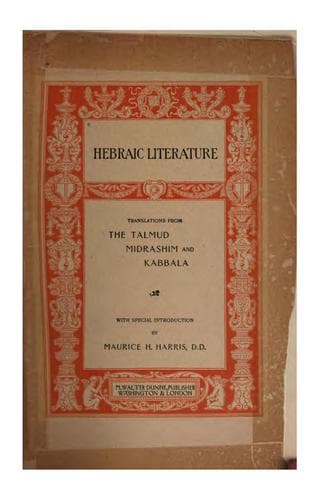
Hebraic Literature; Translations from the Talmud, Midrashim and Kabbala
Religion
Hebraic Literature; Translations from the Talmud, Midrashim and Kabbala
Hebrew literature -- Translations into English
Four dispositions are found among those who sit for instruction, before
the wise, and they may be respectively compared to a sponge, a funnel, a
strainer, and a sieve; the sponge imbibes all, the funnel receives at
one end and discharges at the other, the strainer suffers the wine to
pass through, but retains the lees, and the sieve recovers the bran, but
retains the fine flour.
To pray loudly is not a necessity of devotion; when we pray we must
direct our hearts toward heaven.
Charity is greater than all.
Who gives charity in secret is greater than Moses.
He finds authority for this saying in the words of Moses, "For I was
afraid of the anger," and the words of Solomon which he presents as an
answer, "A gift given in secret pacifieth anger."
A miser is as wicked as an idolater.
Charity is more than sacrifices.
"He who gives (charity) becomes rich," or as it is written, "A
beneficent soul will be abundantly gratified."
One day a philosopher inquired of Rabbi Akiba, "If your God loves the
poor, why does He not support them?"
"God allows the poor to be with us ever," responded Akiba, "that the
opportunities for doing good may never fail."
"But," returned the philosopher, "how do you know that this virtue of
charity pleases God? If a master punishes his slaves by depriving them
of food and clothing, does he feel pleased when others feed and clothe
them?"
"But suppose, on the other hand," said the Rabbi, "that the children of
a tender father, children whom he could no longer justly assist, had
fallen into poverty, would he be displeased if kind souls pitied and
aided them? We are not the slaves of a hard master. God calls us His
children, and Himself we call our Father."
When one stands at the judgment-seat of God these questions are asked:--
"Hast thou been honest in all thy dealings?"
"Hast thou set aside a portion of thy time for the study of the law?"
"Hast thou observed the first commandment?"
"Hast thou, in trouble, still hoped and believed in God?"
"Hast thou spoken wisely?"
All the blessings of a household come through the wife, therefore should
her husband honor her.
Men should be careful lest they cause women to weep, for God counts
their tears.
In cases of charity, where both men and women claim relief, the latter
should be first assisted. If there should not be enough for both, the
men should cheerfully relinquish their claims.
A woman's death is felt by nobody as by her husband.
Tears are shed on God's altar for the one who forsakes his first love.
He who loves his wife as himself, and honors her more than himself, will
train his children properly; he will meet, too, the fulfillment of the
verse, "And thou shalt know that there is peace in thy tent, and thou
wilt look over thy habitation and shall miss nothing."
I never call my wife "wife," but "home," for she, indeed, makes my home.
He who possesses a knowledge of God, and a knowledge of man, will not
easily commit sin.
Public-domain text, read in full here on John Shaqi.
Reviews
Reviews
No reviews yet
Be the first to share your thoughts on this work.
Elsewhere in the archive
Join the Discussion
Join the discussion
Sign in to leave a comment or review.
Sign InorCreate an account