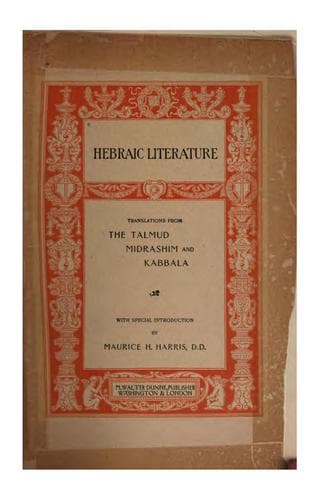
Hebraic Literature; Translations from the Talmud, Midrashim and Kabbala
Religion
Hebraic Literature; Translations from the Talmud, Midrashim and Kabbala
Hebrew literature -- Translations into English
The Bible was given us to establish peace.
He who wrongs his fellow-man, even in so small a coin as a penny, is as
wicked as if he should take life.
He who raises his hand against his fellow in passion is a sinner.
Be not the friend of one who wears the cloak of a saint to cover the
deformities of a fool.
One who gives way to passion is as bad as an idolater.
Hospitality is as great a virtue as studying the law.
"Never put thyself in the way of temptation," advised Rabbi Judah; "even
David could not resist it."
Rabbi Tyra, on being asked by his pupils to tell them the secret which
gained him a happy, peaceful old age, replied, "I have never cherished
anger with my family; I have never envied those greater than myself, and
I have never rejoiced in the downfall of any one."
Unhappy is he who mistakes the branch for the tree, the shadow for the
substance.
Thy yesterday is thy past; thy to-day thy future; thy to-morrow is a
secret.
The best preacher is the heart; the best teacher is time; the best book
is the world; the best friend is God.
Life is but a loan to man; death is the creditor who will one day claim
it.
Understand a man by his own deeds and words. The impressions of others
lead to false judgment.
He through whose agency another has been falsely punished stands outside
of heaven's gates.
The sins of the bad-tempered are greater than his merits.
The man who sins is foolish as well as wicked.
The good actions which we perform in this world take form and meet us in
the world to come.
Better to bear a false accusation in silence, than by speaking to bring
the guilty to public shame.
He who can feel ashamed will not readily do wrong.
There is a great difference between one who can feel ashamed before his
own soul and one who is only ashamed before his fellow-man.
God's covenant with us included work; for the command, "Six days shalt
thou work and the seventh shalt thou rest," made the "rest" conditional
upon the "work."
God first told Adam to dress the Garden of Eden, and to keep it, and
then permitted him to eat of the fruit of his labor.
God did not dwell in the midst of Israel till they had worked to deserve
His presence, for he commanded, "They shall make me a sanctuary, and
then I will dwell in the midst of them."
When Jerusalem was in the hands of the Romans, one of their philosophers
asked of the Rabbis:--
"If your God dislikes idolatry, why does He not destroy the idols and so
put temptation out of the way?"
The wise men answered:--
"Would you have the sun and the moon destroyed because of the foolish
ones who worship them? To change the course of nature to punish sinners,
would bring suffering to the innocent also."
Rabbi Judah said:--
"He who refuses to teach a precept to his pupil is guilty of theft, just
as one who steals from the inheritance of his father; as it is written,
(The law which Moses commanded us is the inheritance of the congregation
of Jacob.) But if he teaches him, what is his reward?"
Public-domain text, read in full here on John Shaqi.
Reviews
Reviews
No reviews yet
Be the first to share your thoughts on this work.
Elsewhere in the archive
Join the Discussion
Join the discussion
Sign in to leave a comment or review.
Sign InorCreate an account