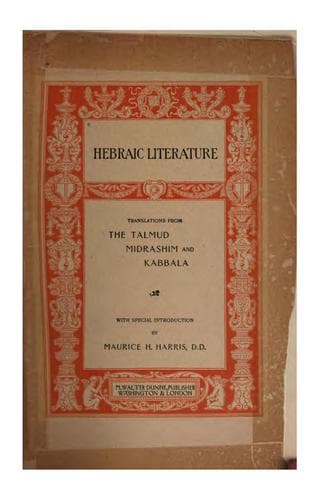
Hebraic Literature; Translations from the Talmud, Midrashim and Kabbala
Religion
Hebraic Literature; Translations from the Talmud, Midrashim and Kabbala
Hebrew literature -- Translations into English
Thus the son had provided for himself a welcome when he should reach the
inn, which was his first wise act.
The landlord said to him, "Who art thou?"
"The son of the merchant who died in thy house," he replied.
They prepared for him a dinner, and placed upon the table five pigeons
and a chicken. The master of the house, his wife, two sons, and two
daughters sat with him at the table.
"Serve the food," said the landlord.
"Nay," answered the young man; "thou art master, it is thy privilege."
"I desire thee to do this thing; thou art my guest, the merchant's son;
pray help the food."
The young man thus entreated divided one pigeon between the two sons,
another between the two daughters, gave the third to the man and his
wife, and kept the other two for himself. This was his second wise act.
The landlord looked somewhat perplexed at this mode of distribution, but
said nothing.
Then the merchant's son divided the chicken. He gave to the landlord and
his wife the head, to the two sons the legs, to the two daughters the
wings, and took the body for himself. This was his third wise act.
The landlord said:--
"Is this the way they do things in thy country? I noticed the manner in
which thou didst apportion the pigeons, but said nothing; but the
chicken, my dear sir! I must really ask thee thy meaning."
Then the young man answered:--
"I told thee that it was not my place to serve the food, nevertheless
when thou didst insist I did the best I could, and I think I have
succeeded. Thyself, thy wife, and one pigeon make three; thy two sons
and one pigeon make three; thy two daughters and one pigeon make three;
and myself and two pigeons make three also, therefore is it fairly done.
As regards the chicken, I gave to thee and thy wife the head, because ye
are the heads of the family; I gave to each of thy sons a leg, because
they are the pillars of the family, preserving always the family name; I
gave to each of thy daughters a wing, because in the natural course of
events they will marry, take wing, and fly away from the home-nest. I
took the body of the chicken because it looks like a ship, and in a ship
I came here and in a ship I hope to return. I am the son of the merchant
who died in thy house; give me the property of my dead father."
"Take it and go," said the landlord. And giving him his father's
possessions the young man departed in peace.
* * * * *
A certain man, a native of Athina (a city near Jerusalem), visited the
city of Jerusalem, and after leaving it, ridiculed the place and its
inhabitants. The Jerusalemites were very wroth at being made the
subjects of his sport, and they induced one of their citizens to travel
to Athina, to induce the man to return to Jerusalem, which would give
them an opportunity to punish his insolence.
Public-domain text, read in full here on John Shaqi.
Reviews
Reviews
No reviews yet
Be the first to share your thoughts on this work.
Elsewhere in the archive
Join the Discussion
Join the discussion
Sign in to leave a comment or review.
Sign InorCreate an account