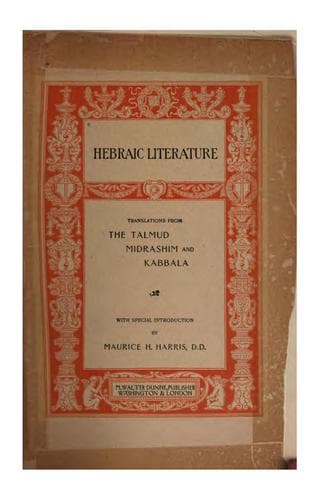
Hebraic Literature; Translations from the Talmud, Midrashim and Kabbala
Religion
Hebraic Literature; Translations from the Talmud, Midrashim and Kabbala
Hebrew literature -- Translations into English
The aged man lived to partake of that very fruit, and remembering the
emperor's words, he resolved to visit him. So, taking a small basket, he
filled it with the choicest figs from the tree, and proceeded on his
errand. Telling the palace guard his purpose, he was admitted to the
sovereign's presence.
"Well," asked the emperor, "what is thy wish?"
The old man replied:--
"Lo, I am the old man to whom thou didst say, on the day thou sawest him
planting a fig tree, 'If thou livest to eat of its fruit, I pray thee
let me know;' and behold I have come and brought thee of the fruit, that
thou mayest partake of it likewise."
The emperor was very much pleased, and emptying the man's basket of its
figs, he ordered it to be filled with gold coins.
When the old man had departed, the courtiers said to the emperor:--
"Why didst thou so honor this old Jew?"
"The Lord hath honored him, and why not I?" replied the emperor.
Now next door to this old man there lived a woman, who, when she heard
of her neighbor's good fortune, desired her husband to try his luck in
the same quarter. She filled for him an immense basket with figs, and
bidding him put it on his shoulder, said, "Now carry it to the emperor;
he loves figs and will fill thy basket with golden coin."
When her husband approached the gates of the palace, he told his errand
to the guards, saying, "I brought these figs to the emperor; empty my
basket I pray, and fill it up again with gold."
When this was told to the emperor, he ordered the old man to stand in
the hallway of the palace, and all who passed pelted him with his figs.
He returned home wounded and crestfallen to his disappointed wife.
"Never mind, thou hast one consolation," said she; "had they been
cocoanuts instead of figs thou mightest have suffered harder raps."
* * * * *
A citizen of Jerusalem traveling through the country was taken very sick
at an inn. Feeling that he would not recover, he sent for the landlord
and said to him, "I am going the way of all flesh. If after my death any
party should come from Jerusalem and claim my effects, do not deliver
them until he shall prove to thee by three wise acts that he is entitled
to them; for I charged my son before starting upon my way, that if death
befell me he would be obliged to prove his wisdom before obtaining my
possessions."
The man died and was buried according to Jewish rites, and his death was
made public that his heirs might appear. When his son learned of his
father's decease he started from Jerusalem for the place where he had
died. Near the gates of the city he met a man who had a load of wood for
sale. This he purchased and ordered it to be delivered at the inn toward
which he was traveling. The man from whom he bought it went at once to
the inn, and said, "Here is the wood."
"What wood?" returned the proprietor; "I ordered no wood."
"No," answered the woodcutter, "but the man who follows me did; I will
enter and wait for him."
Public-domain text, read in full here on John Shaqi.
Reviews
Reviews
No reviews yet
Be the first to share your thoughts on this work.
Elsewhere in the archive
Join the Discussion
Join the discussion
Sign in to leave a comment or review.
Sign InorCreate an account