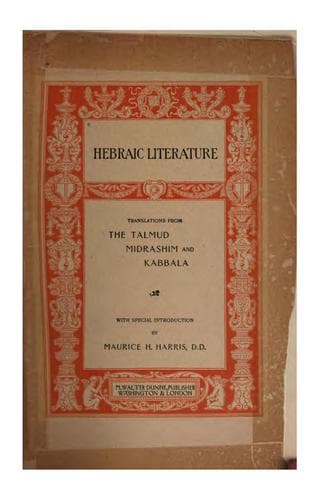
Hebraic Literature; Translations from the Talmud, Midrashim and Kabbala
Religion
Hebraic Literature; Translations from the Talmud, Midrashim and Kabbala
Hebrew literature -- Translations into English
Before he ordered the expedition he endeavored by means of signs, in
accordance with the superstition of his age, to ascertain the result of
the attempt. He shot an arrow from his bow, pointing to the west, and
the arrow turned toward Jerusalem. Then he shot again, pointing toward
the east, and the arrow sped toward Jerusalem. Then he shot once more,
desiring to know in which direction lay the guilty city which should be
blotted from the world, and for the third time his arrow pointed toward
Jerusalem.
When the city had been captured, he marched with his princes and
officers into the Temple, and called out mockingly to the God of Israel,
"And art thou the great God before whom the world trembles, and we here
in thy city and thy Temple!"
On one of the walls he found the mark of an arrow's head, as though
somebody had been killed or hit near by, and he asked, "Who was killed
here?"
"Zachariah, the son of Yehoyadah, the high priest," answered the people;
"he rebuked us incessantly on account of our transgressions, and we
tired of his words, and put him to death."
The followers of Nebuchadnezzar massacred the inhabitants of Jerusalem,
the priests and the people, old and young, women, and children who were
attending school, even babies in the cradle. The feast of blood at last
shocked even the leader of the hostile heathens, who ordered a stay of
this wholesale murder. He then removed all the vessels of gold and
silver from the Temple, and sent them by his ships, to Babel, after
which he set the Temple on fire.
The high priest donned his robe and ephod, and saying, "Now that the
Temple is destroyed, no priest is needed to officiate," threw himself
into the flames and was consumed. When the other priests who were still
alive witnessed this action, they took their harps and musical
instruments and followed the example of the high priest. Those of the
people whom the soldiers had not killed were bound in iron chains,
burdened with the spoils of the victors, and carried into captivity.
Jeremiah the prophet returned to Jerusalem and accompanied his
unfortunate brethren, who went out almost naked. When they reached a
place called Bet Kuro, Jeremiah obtained better clothing for them. And
he spoke to Nebuchadnezzar and the Chaldeans, and said, "Think not that
of your own strength you were able to overcome the people chosen of the
Lord; 'tis their iniquities which have condemned them to this sorrow."
Thus the people journeyed on with crying and moaning until they reached
the rivers of Babylon. Then Nebuchadnezzar said to them, "Sing, ye
people,--play for me,--sing the songs ye were wont to sing before your
great Lord in Jerusalem."
Public-domain text, read in full here on John Shaqi.
Reviews
Reviews
No reviews yet
Be the first to share your thoughts on this work.
Elsewhere in the archive
Join the Discussion
Join the discussion
Sign in to leave a comment or review.
Sign InorCreate an account