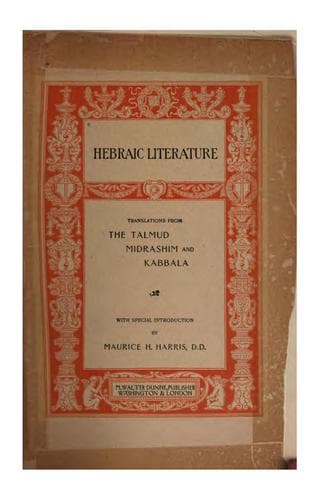
Hebraic Literature; Translations from the Talmud, Midrashim and Kabbala
Religion
Hebraic Literature; Translations from the Talmud, Midrashim and Kabbala
Hebrew literature -- Translations into English
In answer to this command, the Levites hung their harps upon the willow
trees near the banks of the river, as it is written, "Upon the willows
in her midst had we hung up our harps." Then they said, "If we had but
performed the will of God and sung His praises devoutly, we should not
have been delivered into thy hands. Now, how can we sing before thee the
prayers and hymns that belong only to the One Eternal God?" as it is
said, "How should we sing the song of the Lord on the soil of the
stranger?"
Then said the officers of the captors, "These men are men of death; they
refuse to obey the order of the king; let them die."
But forth stepped Pelatya, the son of Yehoyadah, and thus he addressed
Nebuchadnezzar:--
"Behold, if a flock is delivered into the hands of a shepherd, and a
wolf steals a lamb from the flock, tell me, who is responsible to the
owner of the lost animal?"
"Surely the shepherd," replied Nebuchadnezzar.
"Then listen to thine own words," replied Pelatya. "God has given Israel
into thy hands; to Him art thou responsible for those who are slain."
The king ordered the chains to be removed from the captives, and they
were not put to death.
* * * * *
Through Kamtzah and Bar Kamtzah was Jerusalem destroyed; and thus it
happened.
A certain man made a feast; he was a friend of Kamtzah, but Bar Kamtzah
he hated. He sent a messenger to Kamtzah with an invitation to his
banquet, but this messenger making a mistake, delivered the invitation
to his master's enemy, Bar Kamtzah.
Bar Kamtzah accepted the invitation, and was on hand at the appointed
time, but when the host saw his enemy enter his house, he ordered him to
leave at once.
"Nay," said Bar Kamtzah, "now that I am here, do not so insult me as to
send me forth. I will pay thee for all that I may eat and drink."
"I want not thy money," returned the other, "neither do I desire thy
presence; get thee gone at once."
But Bar Kamtzah persisted.
"I will pay the entire expense of thy feast," he said; "do not let me be
degraded in the eyes of thy guests."
The host was determined, and Bar Kamtzah withdrew from the banquet-room
in anger.
"Many Rabbis were present," said he in his heart, "and not one of them
interfered in my behalf, therefore this insult which they saw put upon
me must have pleased them."
So Bar Kamtzah spoke treacherously of the Jews unto the king, saying,
"The Jews have rebelled against thee."
"How can I know this?" inquired the king.
"Send a sacrifice to their Temple and it will be rejected," replied Bar
Kamtzah.
The ruler then sent a well-conditioned calf to be sacrificed for him in
the Temple, but through the machinations of Bar Kamtzah the messenger
inflicted a blemish upon it, and, of course, not being fit for the
sacrifice it was not accepted.
Public-domain text, read in full here on John Shaqi.
Reviews
Reviews
No reviews yet
Be the first to share your thoughts on this work.
Elsewhere in the archive
Join the Discussion
Join the discussion
Sign in to leave a comment or review.
Sign InorCreate an account